
2026-03-04 NASA
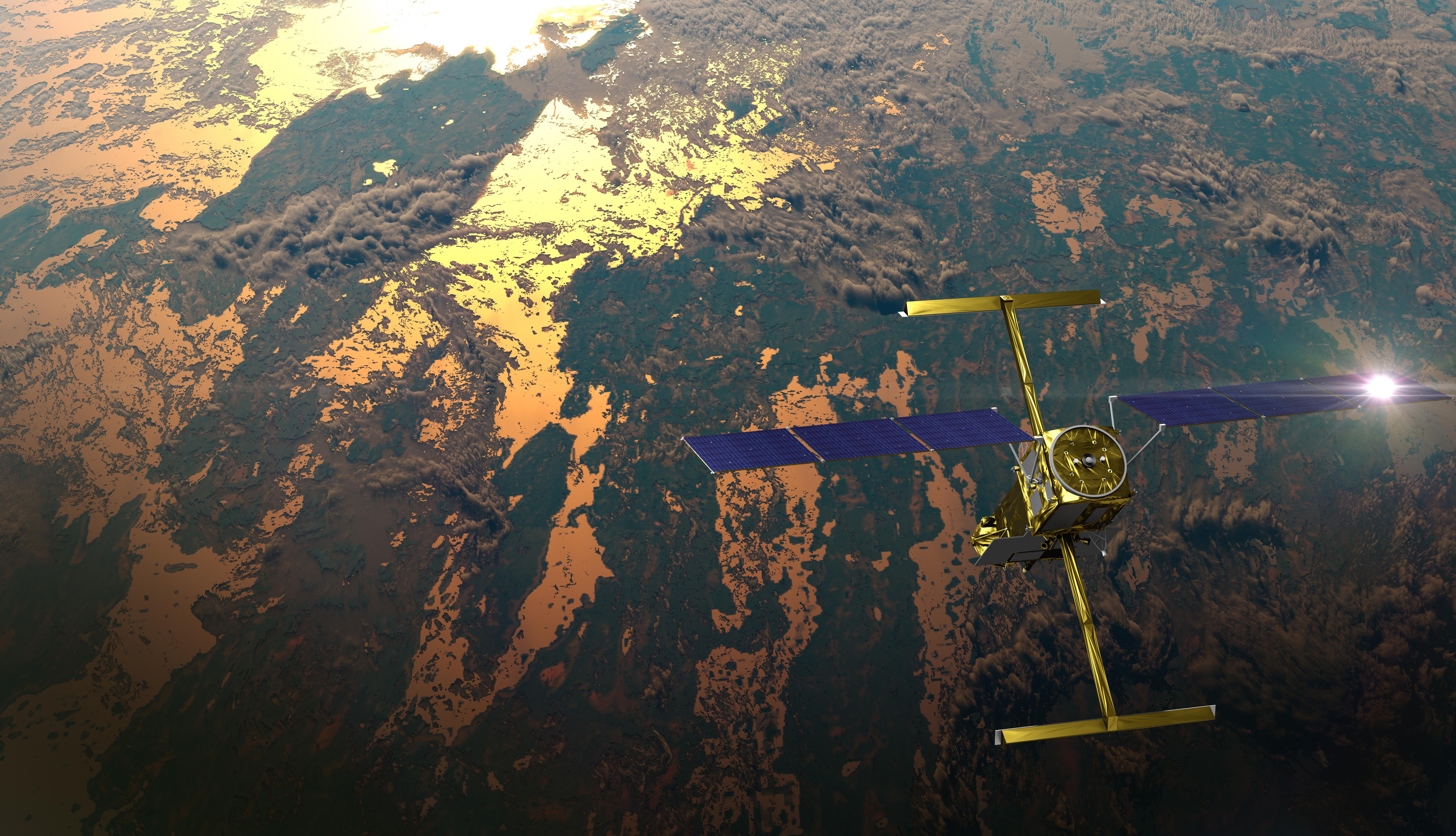
Sunlight glints off one of the solar panels of the SWOT satellite in this artist’s concept. The antennas of the mission’s key instrument — the Ka-band Radar Interferometer (KaRIn) — collect data along a swath 30 miles (50 kilometers) wide on either side of the satellite.CNES
<関連情報>
- https://www.nasa.gov/earth/us-french-satellite-takes-stock-of-worlds-river-water/
- https://www.nature.com/articles/s41586-026-10218-y
広域高度測定地図で世界の河川の河岸形状と貯水量の変化を明らかに Wide-swath altimetry maps bank shapes and storage changes in global rivers
A. Cerbelaud,J. Wade,C. H. David,M. Durand,R. P. M. Frasson,T. Pavelsky &H. Oubanas
Nature Published:04 March 2026
DOI:https://doi.org/10.1038/s41586-026-10218-y
Abstract
Rivers are Earth’s most renewable and accessible freshwater resource1, yet global estimates of the magnitude and variability in river water storage have remained few and inconsistent1,2,3,4,5,6,7,8,9. Previous estimates of variability have relied either on sparse and asynchronous remote-sensing observations10 or on hydrological models constrained by incomplete understanding of surface-water balance and poorly known river channel characteristics2,3. The insufficient knowledge of temporal variations in river water storage across space hinders effective management of this critical freshwater resource11,12. Here we present near-global-scale observations of active river channel geometry and associated monthly changes in water storage at the reach scale derived from the first water year (October 2023 to September 2024) of the Surface Water and Ocean Topography (SWOT) mission at 126,674 reaches worldwide. Clear patterns of riverbed shape and storage variability expectedly emerge across major basins. SWOT reveals a range of 313.1 ± 129.5 km³ in global annual river storage variability, approximately 28% lower than the lowest previously modelled estimates for the same wide reaches. Although the Amazon’s 2024 record drought, the observational challenges in the Arctic and the revisit frequency of SWOT almost certainly contribute to the discrepancy, the observations point to distinct knowledge limitations in surface-water science. These findings highlight key opportunities to improve the fundamental representation of surface-water dynamics in global models and to better inform water resource management and disaster mitigation at scale.

