2026-02-24 国立極地研究所,東京大学,九州大学,総合研究大学院大学,統計数理研究所,高知大学
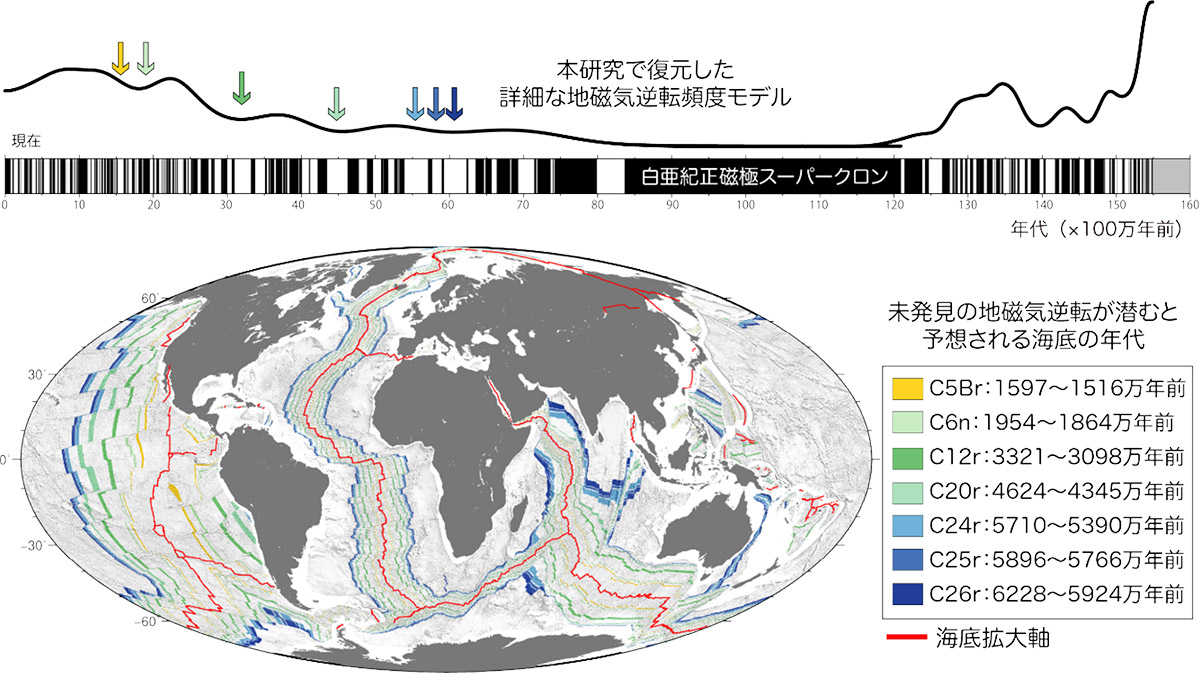
本研究で復元した詳細な地磁気逆転頻度モデルを黒線で示す。白黒の帯が地磁気極性年代表(Ogg, 2020, Geologic Time Scale 2020, Elsevierのデータを用いて作図)。地球の海底構造図には、「未発見の地磁気逆転」が潜むと思われる海底の年代を色付きのエリアで示す(Müller et al., 2019, Tectonicsのデータを用いて作図)。
<関連情報>
- https://www.nipr.ac.jp/info2025/20260224.html
- https://agupubs.onlinelibrary.wiley.com/doi/10.1029/2025GL120557
適応型カーネル密度推定を用いた地磁気逆転頻度モデルによる地磁気逆転の欠落の証拠 Evidence for Missing Geomagnetic Reversals From Geomagnetic Reversal Frequency Model Using Adaptive Kernel Density Estimation
Yutaka Yoshimura, Masakazu Fujii, Hideitsu Hino, Shotaro Akaho, Satoshi Kuriki, Osamu Ishizuka, Toshitsugu Yamazaki, Hyeon-Seon Ahn, Tesfaye Kidane, Yuhji Yamamoto, Yo-ichiro Otofuji
Geophysical Research Letters Published: 23 February 2026
DOI:https://doi.org/10.1029/2025GL120557
Abstract
The existence of missing geomagnetic reversals has been proposed, with potential for new magnetostratigraphic age controls. We estimate geomagnetic reversal frequency from 0 to 155 Ma using adaptive-bandwidth kernel density estimation (AKDE) to evaluate data sparseness and to assess how reversal frequency changes when recently identified geomagnetic reversals are incorporated into the geomagnetic polarity time scale (GPTS) data set. AKDE is a two-stage procedure that uses an initial density estimator based on an initial (pilot) bandwidth. We found that the pilot bandwidth determined using cross-validation is stable with respect to data set length. The AKDE results obtained based on the cross-validated pilot bandwidth reveal four troughs after the Cretaceous Normal Superchron, spaced 13.5–15.0 Myr apart and corresponding to relatively long chrons (>0.8 Myr). One trough near 32 Ma becomes less distinct after the four recently identified reversals are added to the data set. This sensitivity suggests that troughs in the frequency curve may indicate missing geomagnetic reversals.
Plain Language Summary
Earth’s magnetic field has flipped many times in the past. Geologists use the timing of these flips, summarized in the geomagnetic polarity time scale (GPTS), to date rocks and sediments, but some flips may be missing from the standard timeline. We employed a statistical method of adaptive-bandwidth kernel density estimation to estimate the frequency of flips that occurred between approximately 155 million years ago and the present, and we inquired about the impact on this estimate when four newly recognized flips around 31 million years ago are incorporated into the GPTS timeline. Our analysis reveals fine-scale features of the geomagnetic reversal frequency over time and four intervals with unusually few flips after the end of a long, stable period in the Cretaceous. These low-activity intervals are separated by about 12–15.5 million years and align with unusually long periods of constant magnetic polarity. When the four new flips are included, the low-activity interval near 32 million years ago becomes less distinct. This pattern suggests that low-activity intervals may mark places where flips are still missing from the record.
Key Points
- We modeled the geomagnetic reversal frequency using adaptive-bandwidth kernel density estimation and found several troughs
- Recently discovered reversals at ∼31 Ma added to geomagnetic polarity time scale suppressed one trough around 32 Ma
- We concluded that the troughs in geomagnetic reversal frequency indicate missing geomagnetic reversals