2026-01-27 ロイヤルメルボルン工科大学(RMIT)
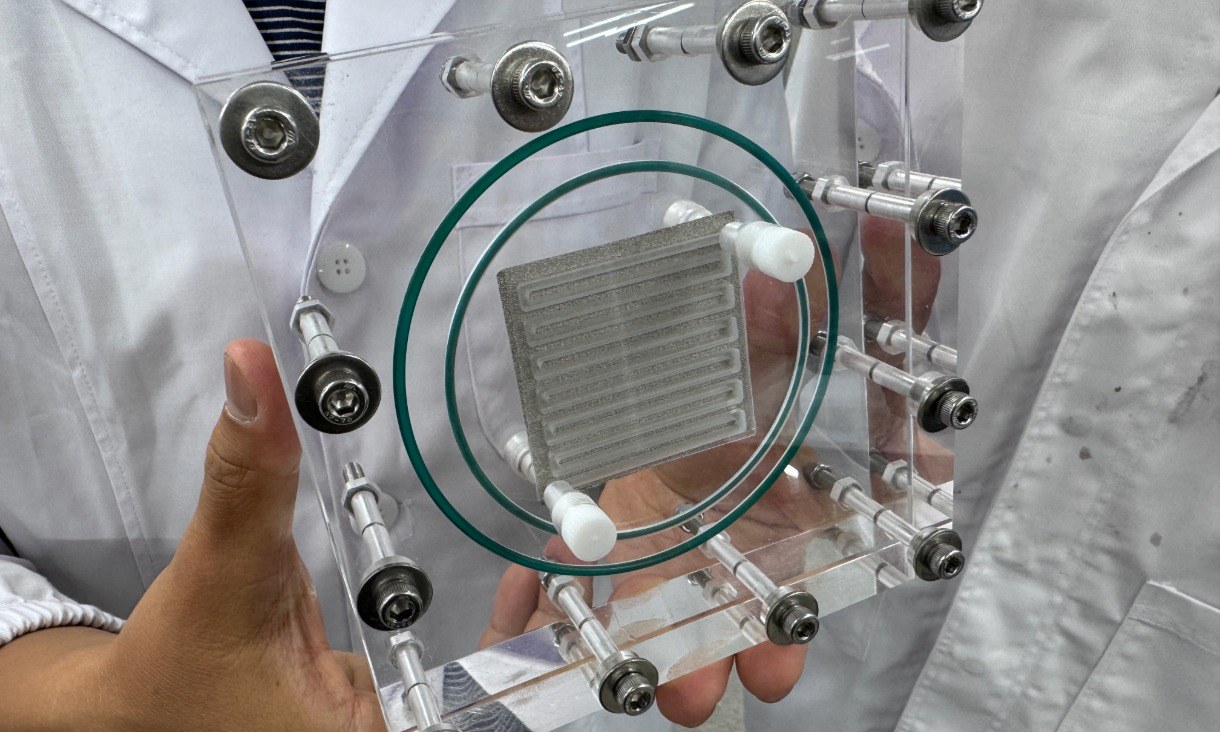
A key component of the team’s 3 kW carbon conversion prototype device. Credit: Will Wright, RMIT University
<関連情報>
- https://www.rmit.edu.au/news/all-news/2026/jan/carbon-conversion
- https://www.nature.com/articles/s41560-025-01869-8
ピペラジンカルバメート直接還元によるタンデムアミン洗浄とCO2電気分解 Tandem amine scrubbing and CO2 electrolysis via direct piperazine carbamate reduction
Peng Li,Yu Mao,Heejong Shin,Qi Yang,Xuan Cheng,Yitong Li,Kangkang Li,Hai Yu,Roger Mulder,Wei Kong Pang,Huanyu Jin,Yong Zhao,Zhi Zheng,Emily Finch,Kyle Hearn,Baohua Jia,Geoffrey I. N. Waterhouse,Ziyun Wang & Tianyi Ma
Nature Energy Published:11 September 2025
DOI:https://doi.org/10.1038/s41560-025-01869-8
Abstract
Transforming CO2 into valuable products presents a promising route for reducing emissions across various industry sectors. However, conventional methods, including sequential CO2 electrolysis or reverse water–gas shift reaction, depend on energy-intensive CO2 purification; while emerging reactive CO2 capture strategies still face challenges in designing optimal system components that enable efficient electrochemical regeneration without compromising catalytic performance. Here we systematically screen a broad library of amine-based absorbents to establish a design rationale for tandem amine scrubbing and CO2 electrolysis. We identify piperazine as an optimal capture medium and show that its carbamate form can be directly reduced using a nickel single-atom catalyst. This charge-neutral intermediate facilitates spontaneous adsorption, rapid transport and efficient C–N bond cleavage, enabling stable carbon monoxide production alongside in situ amine regeneration. The process achieves an energy efficiency of ~48.8 GJ per tonne CO, offering a scalable and energy efficient pathway towards carbon-neutral chemical feedstocks.