2025-12-10 アリゾナ大学
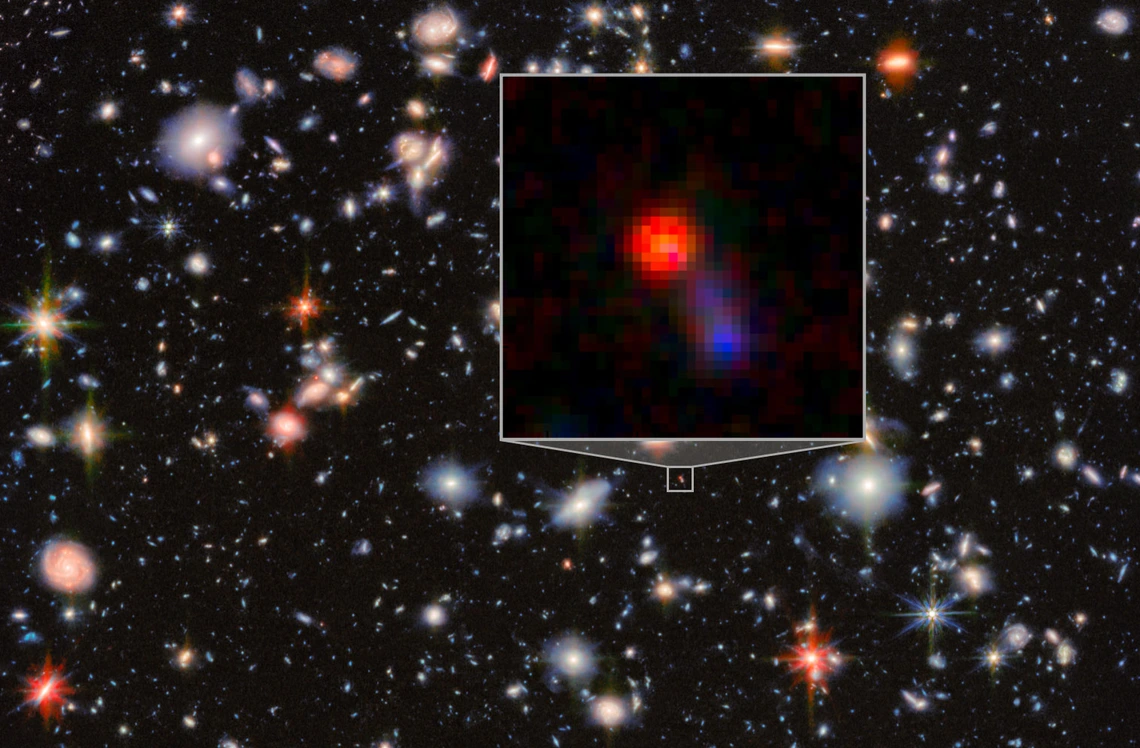
Covering a tiny patch of sky spanning less than a tenth of the full moon, the famous “Hubble eXtreme Deep Field” image revealed thousands of galaxies, including objects from the universe infancy. The James Webb Space Telescope observed the same region over three years. U of A researchers zoomed in on the galaxy reported in this study (inset), captured when the universe was only 800 million years old. The team found that even at its young age, it already harbored a supermassive black hole, shrouded in dust.ESA/Webb, NASA & CSA, G. Östlin, P. G. Perez-Gonzalez, J. Melinder, the JADES Collaboration, M. Zamani (ESA/Webb)
<関連情報>
- https://news.arizona.edu/news/monster-hiding-plain-sight-jwst-reveals-cosmic-shapeshifter-early-universe
- https://iopscience.iop.org/article/10.3847/1538-4357/ae089c
ヴァージルの性質を解読する:宇宙再電離期に一見正常なLyα放射源の中に潜む隠された活動銀河核 Deciphering the Nature of Virgil: An Obscured Active Galactic Nucleus Lurking within an Apparently Normal Lyα Emitter during Cosmic Reionization
Pierluigi Rinaldi, Pablo G. Pérez-González, George H. Rieke, Jianwei Lyu, Francesco D’Eugenio, Zihao Wu, Stefano Carniani, Tobias J. Looser, Irene Shivaei, Leindert A. Boogaard,…
The Astrophysical Journal Published: 2025 November 17
DOI:10.3847/1538-4357/ae089c
Abstract
We present a comprehensive analysis of the MIRI Extremely Red Object Virgil, a Lyα emitter at zspec = 6.6379 ± 0.0035 with the photometric properties of a Little Red Dot. Leveraging new JWST/MIRI imaging from the MIDIS and PAHSPECS programs, we confirm Virgil’s extraordinary nature among galaxies in JADES/GOODS-South, exhibiting a strikingly red NIRCam-to-MIRI color (F444W–F1500W = 2.84 ± 0.04 mag). Deep NIRSpec/PRISM spectroscopy from the OASIS program offers key insights into the host galaxy, revealing properties of an average star-forming galaxy during Cosmic Reionization, such as a subsolar metallicity, low-to-moderate dust content, and a relatively high ionization parameter and electron temperature. By estimating the star formation rate of Virgil from UV and Hα, we find evidence that the galaxy is either entering or fading out of a bursty episode. Although line-ratio diagnostics employed at high z would classify Virgil as an active galactic nucleus (AGN), this classification becomes ambiguous once redshift evolution is considered. Nonetheless, Virgil occupies the same parameter space as recently confirmed AGNs at similar redshifts. The new deep MIRI data at 15 μm reinforce the AGN nature of Virgil, as inferred from multiple spectral energy distribution (SED) fitting codes. Virgil’s rising infrared SED and UV excess resemble those of Dust-Obscured Galaxies (DOGs) studied with Spitzer at Cosmic Noon, particularly blue-excess HotDOGs. Our results highlight the need for a multiwavelength approach incorporating MIRI to uncover such extreme sources at z ≳ 6 and to shed light on the interplay between galaxy evolution and early black hole growth during Cosmic Reionization.