2025-11-27 産業技術総合研究所
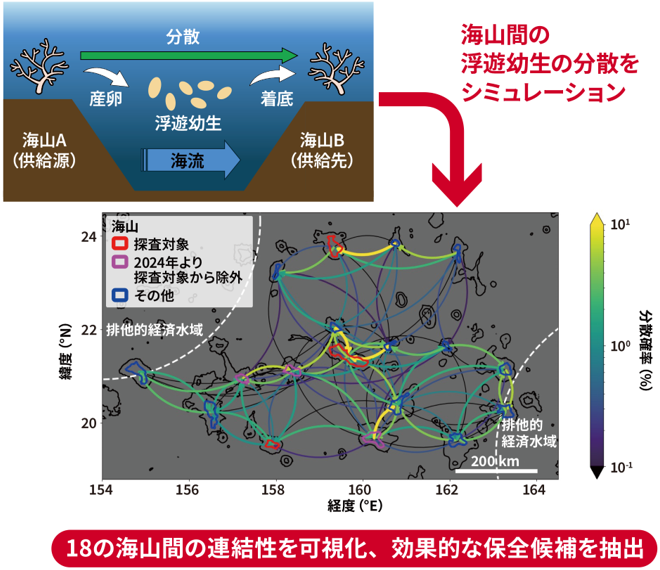
浮遊幼生の分散シミュレーションによる、18の海山間の連結性の可視化
※原論文の図を引用・改変したものを使用しています。
<関連情報>
- https://www.aist.go.jp/aist_j/press_release/pr2025/pr20251127/pr20251127.html
- https://esajournals.onlinelibrary.wiley.com/doi/full/10.1002/eap.70086
海山幼生分散ネットワーク:深海採掘から生態系の連結性を守るための潜在的な戦略 Seamount larval dispersal networks: A potential strategy for conserving ecological connectivity from deep-sea mining
Naoki Saito, Hiroki Kise, Travis W. Washburn, Eri Ikeuchi, Akira Iguchi, Hiroko Kamoshida, Atsushi Suzuki
Ecological Applications Published: 23 November 2025
DOI:https://doi.org/10.1002/eap.70086
Abstract
Seamounts are unique habitats in the deep sea facing anthropogenic stressors, including future deep-sea mining. To conserve patchy marine habitats such as seamounts, it is critical to design conservation area networks that maintain connectivity by larval dispersal. This study conducted biophysical modeling to quantify larval dispersal among 18 seamounts in the Northwest Pacific, within the scope of a regional environmental management plan for mining under development by the International Seabed Authority. Seamounts formed a single dispersal network, but excluding seamounts with mining potential showed the network could become fragmented. Two seamounts whose mining potential was relinquished in 2024 were identified as key stepping stones, suggesting that environmental conservation at these two seamounts can contribute to maintaining a single dispersal network. Predominant eastward or westward currents, likely related to the North Equatorial Intermediate Current, made the upstream, distant seamounts vital larval sources. Trajectories of Argo floats and gene flows of amphipods provided physical and biological support for the modeled dispersal. This study highlights the potential for effective conservation area placement based on a seamount network connected by upstream-based larval dispersal.