2025-11-20 シンガポール国立大学(NUS)
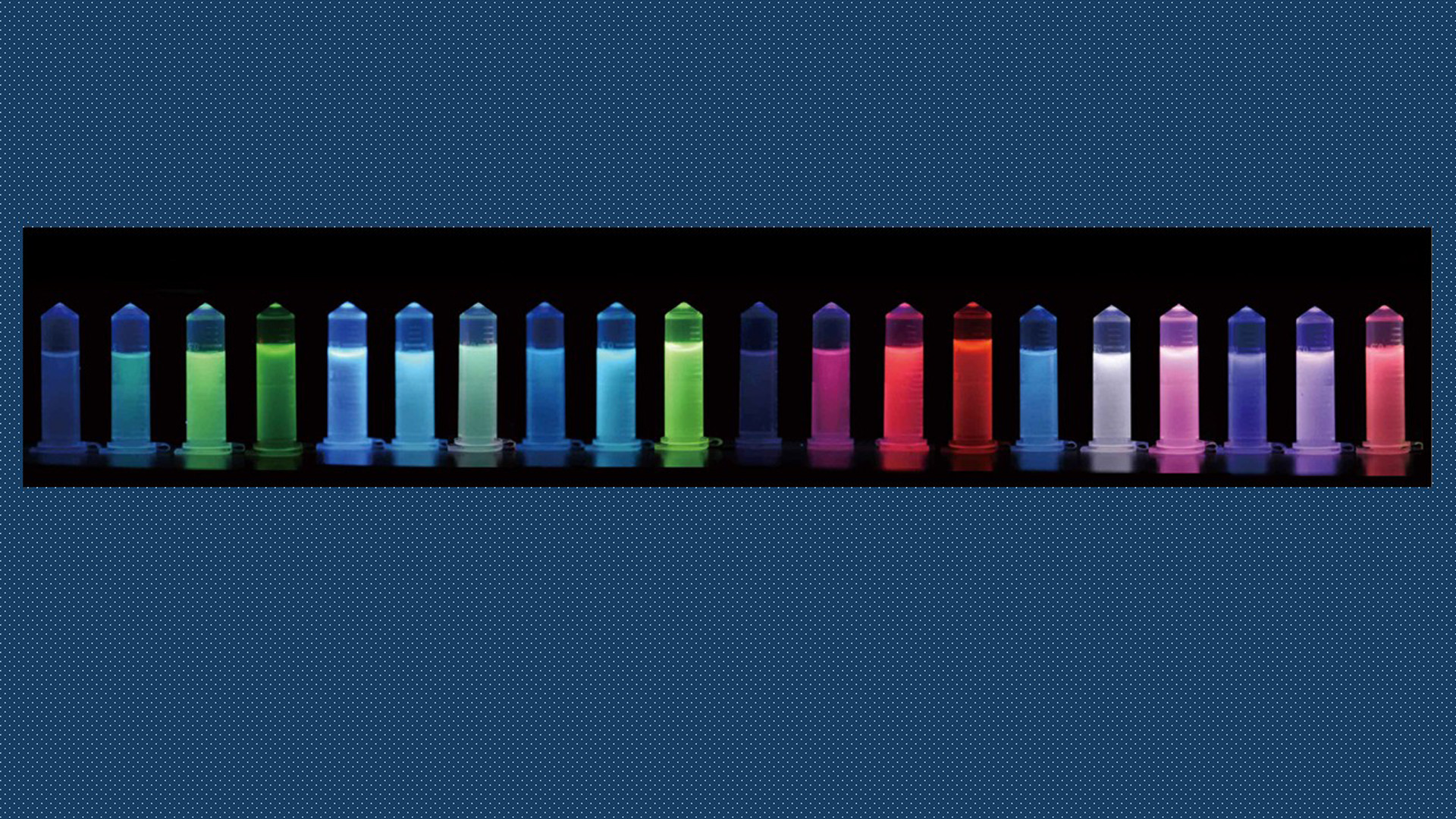
Tuning light at the nanoscale: Photographed under 365-nm UV light, these vials display the distinctive luminescence of lanthanide-doped nanocrystals. The shifting palette from blue and green to red and near-white captures how engineered energy landscapes translate into precise, tunable emission across the visible spectrum.
<関連情報>
- https://news.nus.edu.sg/illuminating-new-possibilities-with-lanthanide-nanocrystals/
- https://www.nature.com/articles/s41586-025-09717-1
調整可能なランタニド発光のための電気生成励起子 Electro-generated excitons for tunable lanthanide electroluminescence
Jing Tan,Peng Zhang,Xiaoqing Song,Chunmiao Han,Feng Wang,Jing Zhang,Chunbo Duan,Zhilong Zhang,Sanyang Han,Hui Xu & Xiaogang Liu
Nature Published:19 November 2025
DOI:https://doi.org/10.1038/s41586-025-09717-1
Abstract
Lanthanide nanocrystals offer unique advantages for electroluminescence (EL) applications, including narrow-band emission, high colour purity and compositionally tunable output1,2,3,4. However, their insulating nature poses a challenge for carrier transport and injection, impeding their application in electrically driven optoelectronic devices5. Here we demonstrate efficient EL from insulating lanthanide fluoride nanocrystals (4 nm; NaGdF4:X; X = Tb3+, Eu3+ or Nd3+) coated with a series of functionalized 2-(diphenylphosphoryl)benzoic acids (ArPPOA). These ligands, featuring donor–phosphine oxide acceptor hybrids with carboxyl and P=O coordination sites, effectively sensitize the luminescence of lanthanide nanocrystals by modulating the intraligand charge transfer characteristics. Ultrafast spectroscopic investigations reveal that strong coupling between ArPPOA and lanthanide nanocrystals facilitates intersystem crossing (ISC; <1 ns) and highly efficient triplet energy transfer to nanocrystals (up to 96.7%). Through careful control of dopant composition and concentration in nanocrystals, we also achieve wide-ranging multicolour EL without altering the device architecture, reaching an external quantum efficiency exceeding 5.9% for Tb3+. This ligand-functionalized nanocrystal platform provides a modular strategy for exciton control in insulating nanocrystal systems, offering a pathway for spectrally precise electroluminescent materials.