2025-09-05 農研機構,東北大学,帯広畜産大学,理化学研究所
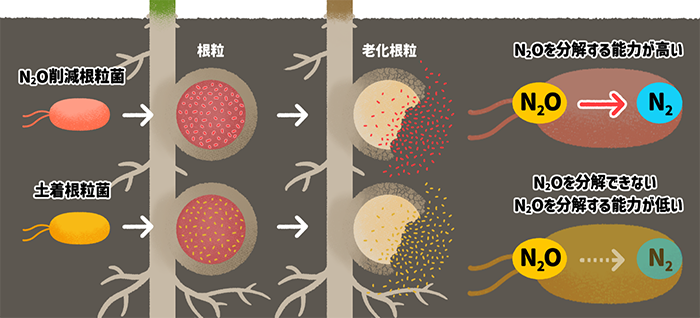
図1 N2O削減根粒菌と土着根粒菌
<関連情報>
- https://www.naro.go.jp/publicity_report/press/laboratory/nias/170932.html
- https://www.nature.com/articles/s41467-025-63223-6
大豆宿主とブラディリゾビウム属内共生菌の遺伝子設計により、大豆根圏からの亜酸化窒素(N₂O)排出を低減 Genetic design of soybean hosts and bradyrhizobial endosymbionts reduces N2O emissions from soybean rhizosphere
Hanna Nishida,Manabu Itakura,Khin Thuzar Win,Feng Li,Kaori Kakizaki,Atsuo Suzuki,Satoshi Ohkubo,Luong Van Duc,Masayuki Sugawara,Koji Takahashi,Matthew Shenton,Sachiko Masuda,Arisa Shibata,Ken Shirasu,Yukiko Fujisawa,Misa Tsubokura,Hiroko Akiyama,Yoshikazu Shimoda,Kiwamu Minamisawa & Haruko Imaizumi-Anraku
Nature Communications Published:04 September 2025
DOI:https://doi.org/10.1038/s41467-025-63223-6
Abstract
Soybeans fix atmospheric N2 through symbiosis with rhizobia. The relationship between rhizobia and soybeans, particularly those with high nitrous oxide (N2O)-reducing (N2OR) activities, can be leveraged to reduce N2O emissions from agricultural soils. However, inoculating soybeans with these rhizobia under field conditions often fails because of the competition from indigenous rhizobia that possess low or no N2OR activity. In this work, we utilize natural incompatibility systems between soybean and rhizobia to address this challenge. Specifically, Rj2 and GmNNL1 inhibit certain rhizobial infections in response to NopP, an effector protein. By combining a soybean line with a hybrid accumulation of the Rj2 and GmNNL1 genes and bradyrhizobia lacking the nopP gene, we develop a soybean-bradyrhizobial symbiosis system in which strains with high N2OR activity predominantly infect. Our optimize symbiotic system substantially reduces N2O emissions in field and laboratory tests, presenting a promising approach for sustainable agricultural practices.