2026-08-25 スタンフォード大学
<関連情報>
- https://news.stanford.edu/stories/2026/08/planets-theory-defying-atmospheres-cosmic-sandbar
- https://iopscience.iop.org/article/10.3847/2041-8213/ae9743
進化し続ける宇宙の海岸線と砂州が岩だらけの無風の谷を囲んでいる An Evolving Cosmic Shoreline and Sandbar Bounding the Rocky Airless Valley
Barron K. Nguyen, Laura K. Schaefer, Xuan Ji (纪璇), Christopher A. Theissen, Fei Dai (戴飞), Bo Peng (彭博), Yao Tang (唐尧), Andrea Zorzi, Michelle Hill, and Megan Weiner Mansfield
The Astrophysical Journal Letters Published: 2026 August 25
DOI:10.3847/2041-8213/ae9743
Abstract
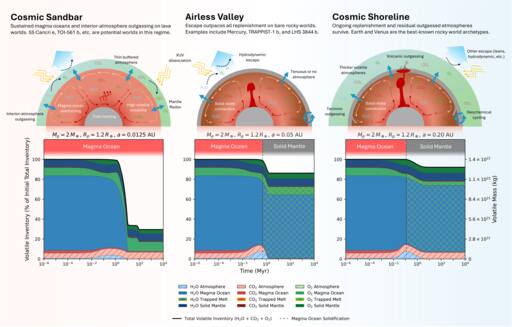
Recent JWST observations challenge the traditional “cosmic shoreline” from both sides, revealing thick volatile atmospheres on the hottest close-in “lava worlds,” where irradiation should drive the most extreme escape, and bare rocky surfaces on cooler terrestrial planets around M dwarfs, where atmospheres would be expected to survive. Using a coupled atmosphere-interior evolution model, we show that atmosphere retention is governed not by a single escape boundary but by two: a hot, outgassing-regulated “cosmic sandbar” and a cooler, escape-regulated “cosmic shoreline,” separated by an “airless valley” that may mark a graveyard of stripped sub-Neptune cores. The sandbar arises because long-lived magma oceans, sustained further by tidal heating from secular eccentricity excitation in multi-planet systems, keep most volatiles dissolved and expose only a small atmospheric reservoir to escape, whereas cooler planets solidify, sequestering volatiles in the deep solid mantle while overexposing the rest to loss. This two-regime structure recasts the single cosmic shoreline as two boundaries set by distinct physics: outgassing and escape. We provide time-evolving fits for both boundaries across G, K, and M stellar types as a function of volatile inventory, planetary mass, age, and tidal heating. Lava worlds with thick atmospheres are unlikely around stars cooler than K-type unless sustained by extreme tidal and/or other interior heating. This framework links atmosphere survival from ultra-short-period planet lava worlds to habitable zone planets, informing target selection and interpretation for TRAPPIST-1 and JWST Director’s Discretionary Time characterization.