
2026-08-11 中国科学院(CAS)
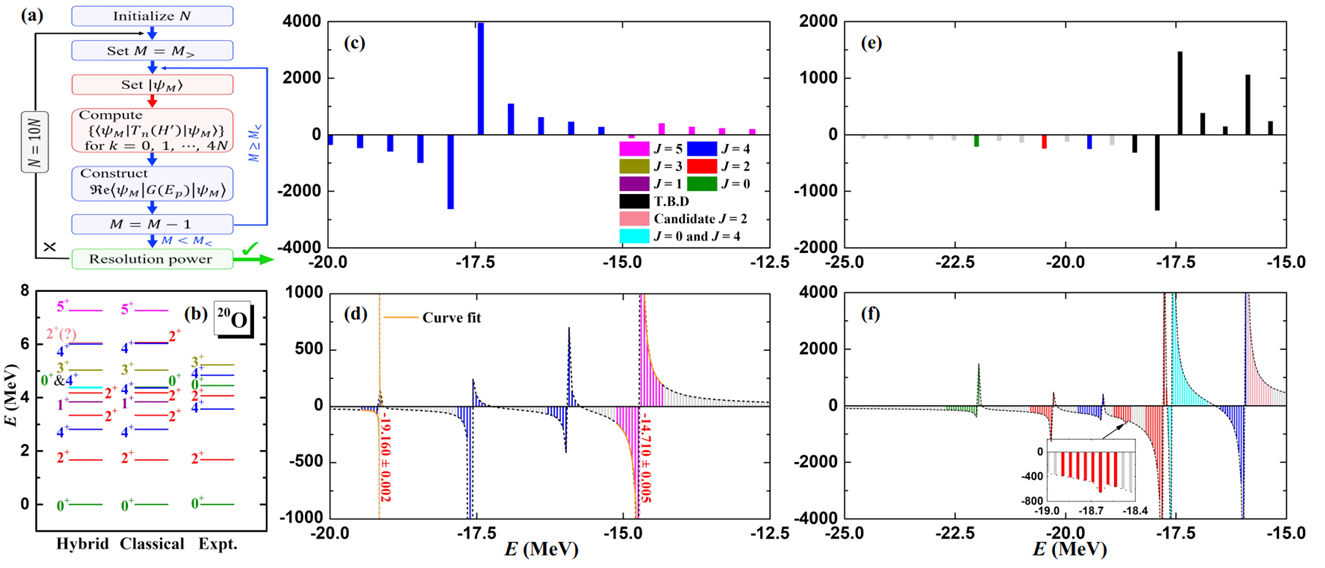
(a) Schematic illustration of the quantum-classical hybrid algorithm framework. (b) Excitation energies and total angular momentum J values of the energy eigenstates of oxygen-20 calculated based on this framework, and their comparison with classical full configuration interaction results and experimental values. (c-f) Schematic illustrations of spectral-function scans of oxygen-20 under different total angular momentum projections and energy resolutions. (Image from IMP)
<関連情報>
- https://english.cas.cn/newsroom/research-news/202608/t20260811_1187811.shtml
- https://journals.aps.org/prc/abstract/10.1103/1spg-5ld3
量子コンピュータ上での第一原理多フェルミオン構造計算 Ab initio many-fermion structure calculations on a quantum computer
Weijie Du, Yangguang Yang, Zixin Liu, Chao Yang, and James P. Vary
Physical Review C Published: 12 June, 2026
DOI: https://doi.org/10.1103/1spg-5ld3
Abstract
To overcome the limitations of existing algorithms for solving self-bound quantum many-body problems—such as those encountered in nuclear and particle physics—that access only a restricted subset of energy levels and provide limited structural information, we introduce and demonstrate a novel quantum-classical approach capable of resolving the complete bound-state spectrum. This method also provides the total angular momentum associated with each eigenstate. Our approach is based on expressing the Hamiltonian in second-quantized form within a novel input model combined with a scan scheme, enabling broad applicability to configuration-interaction calculations across diverse fields. We apply this hybrid method to compute, for the first time, the bound-state spectrum together with corresponding values of 20O using a realistic strong-interaction Hamiltonian. Our approach applies to hadron spectra and values solved in the relativistic basis light-front quantization approach.

