2026-05-06 ペンシルベニア州立大学(Penn State)
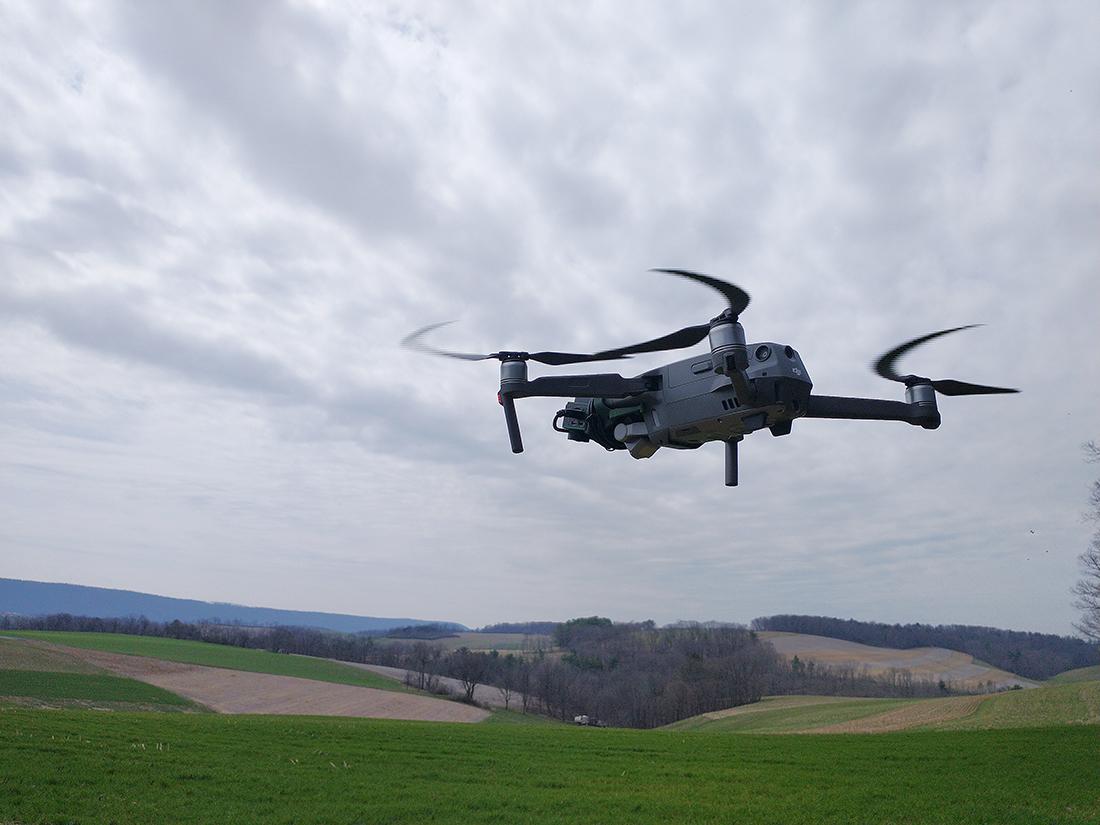
Farmers and researchers can use drones and photogrammetry to map runoff and pollution-risk areas with great accuracy, making precision agriculture more accessible. Credit: Jhony Armando Benavides-Bolaños / Penn State. Creative Commons
<関連情報>
- https://www.psu.edu/news/research/story/drones-match-farm-planning-effectiveness-more-expensive-tech-study-finds
- https://www.sciencedirect.com/science/article/pii/S0168169926002991
水文学的に敏感な地域およびリンの重要な発生源地域をマッピングするための無人航空機写真測量 Unmanned Aerial Vehicle photogrammetry for mapping hydrologically sensitive and phosphorus critical source areas
Jhony Armando Benavides-Bolaños, Daniel Guarín, Patrick Joseph Drohan, Dimitrios Bolkas, Alejandro Pérez Y Soto-Domínguez
Computers and Electronics in Agriculture Available online: 25 March 2026
DOI:https://doi.org/10.1016/j.compag.2026.111704
Highlights
- Drone photogrammetry matched airborne laser maps for runoff risk at field scale.
- Hydrologically sensitive areas and phosphorus hotspots matched legacy laser maps.
- Two-meter resolution supported reliable runoff pathways and risk indices.
- Random checkpoints (400–1000 per site) stabilized elevation accuracy tests.
- One-day field plan feasible with firm access, power-line awareness, backups.
Abstract
Modern hydrologically sensitive areas (HSA) and phosphorus critical source areas (P CSA) mapping relies on expensive LiDAR-derived digital elevation models (DEMs), limiting widespread application in precision nutrient management (PNM). This study evaluated whether Unmanned Aerial Vehicles (UAVs) with Structure from Motion (SfM) photogrammetry can produce HSA and P CSA indices comparable to LiDAR-derived products at sub-watershed scales. Four agricultural sites in eastern Pennsylvania were surveyed in 2022 using UAVs, with SfM-DEMs validated against 2017 LiDAR using 400–1000 randomly distributed control points per site. HSA/P CSA indices were generated from both elevation datasets using identical soil-P inputs and 2-m processing. SfM and LiDAR elevations showed excellent correlations (r = 0.9989–0.9997, p < 0.001) with acceptable RMSE values (0.57–1.12 m). Linear regression indicated strong relationships for HSA areas (R2 = 0.98, p < 0.01) and P CSA areas (R2 = 0.99, p < 0.01). HSA differences ranged from + 0.01% to + 1.53%, and P CSA differences remained < 1% across sites. The UAV-SfM products can effectively replace LiDAR for HSA and P CSA delineation, offering cost-effective, rapid-deployment alternatives for PNM applications. However, reliable application depends on even placement of ground-control points across the site; future work should propagate DEM uncertainty through HSA/P CSA derivation and estimate interannual background elevation change to separate method effects from genuine surface change.