2026-03-12 中国科学院(CAS)
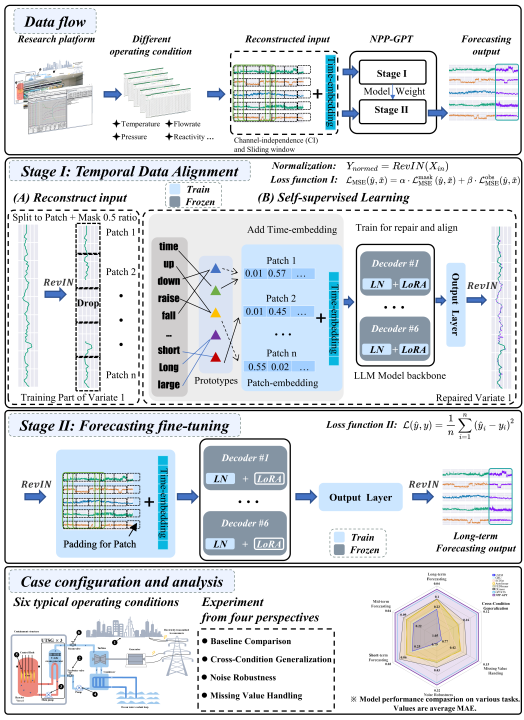
The framework of the proposed NPP-GPT in nuclear energy systems (Image by CHANG Ling)
<関連情報>
- https://english.hf.cas.cn/nr/rn/202603/t20260312_1152629.html
- https://www.sciencedirect.com/science/article/abs/pii/S0306261926000905
NPP-GPT: Forecasting nuclear power plants operating parameters using pre-trained large language model
Ling Chang, Haibo Yu, Minghan Yang, Ziheng Zhang, Shuai Chen, Jianye Wang
Applied Energy Available online: 29 January 2026
DOI:https://doi.org/10.1016/j.apenergy.2026.127438
Highlights
- Proposes NPP-GPT, a novel large language model-based approach with two-stage cross-modal transfer learning for forecasting nuclear power plant operating parameters.
- Bridges modality gaps and integrates domain knowledge through redesigned input embedding, masked self-supervised learning, and fine-tuning.
- Validates method efficacy through comparative, generalization, and robustness experiments across six typical operational scenarios.
Abstract
Accurate long-term forecasting of operating parameters in nuclear power plants (NPPs) is crucial for safety and cost-effective maintenance. However, the complexity and uncertainty of reactors, along with the high-dimensional and large-scale operating data, present challenges in capturing intricate dynamic behaviors and long-term dependencies. This paper presents NPP-GPT, which for the first time investigates the potential of using pre-trained Large Language Model (LLM) to forecast long-term parameters from historical NPP data without explicit prompt engineering. Considering the modal disparity between textual pre-training data and numerical energy data, NPP-GPT employs a two-stage cross-modal transfer learning strategy that preserves the native next-token forecasting capability of LLMs while unlocking their potential for precise energy forecasting. First, the modal gap is bridged through input embedding reconstruction and Self-Supervised Learning (SSL). Second, domain-specific energy knowledge is integrated via LoRA fine-tuning. The framework was rigorously validated using data from an established advanced nuclear energy research platform, focusing on a Chinese Pressurized Water Reactor (CPR-1000). Comprehensive experiments covering diverse operational scenarios, including normal and multiple fault conditions, demonstrated that NPP-GPT outperforms both classical and advanced time-series forecasting models in accuracy and generalization, especially in long-term forecasting and under conditions with noise and missing data. This study offers a novel and generalizable solution for forecasting tasks in energy sectors.