2026-03-03 琉球大学
安田女子大学、フランスINRAE、琉球大学などの研究チームは、植物が鉄欠乏環境で鉄を効率的に吸収する仕組みに関わる新しい輸送体NPF7.2を世界で初めて同定した。アブラナ科植物は鉄不足になると、鉄を可溶化する化合物「クマリン」を根から分泌して鉄吸収を促進するが、クマリンが根の細胞にどのように集積するかは不明だった。研究では、シロイヌナズナのNPF7.2がクマリンを根の表皮細胞と皮層細胞へ取り込む輸送体として働き、細胞内に蓄積させることで土壌へのクマリン分泌を増強し、鉄吸収を高めることを明らかにした。NPF7.2機能欠損株ではクマリン分泌が低下し成長も阻害されたことから、この輸送体が鉄獲得に重要であることが示された。本成果は鉄欠乏土壌でも育つ作物の育種や、作物中の鉄含量を高めるバイオフォーティフィケーションへの応用が期待される。
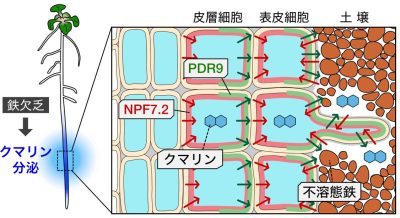
クマリン取込み輸送体NPF7.2によるクマリン分泌促進モデル
<関連情報>
アラビドプシスNPF7.2は根の鉄獲得のためのクマリンの取り込みを媒介する The Arabidopsis NPF7.2 mediates coumarin uptake for root iron acquisition
Shunsuke Watanabe, Meijie Li, Alice Rossille, Chérhazad Boustani, Kevin Robe, Yuri Kanno, Mitsunori Seo, Christian Dubos
New Phytologist Published: 02 March 2026
DOI:https://doi.org/10.1111/nph.70993
Summary
- Iron (Fe) is a transition metal necessary for achieving essential physiological processes throughout the plant lifecycle. In Arabidopsis thaliana, secreting Fe-mobilizing coumarins (FMC) is a key mechanism enabling roots to acquire nonbioavailable Fe present in soils.
- Here, we unveil the pivotal role played by NRT1/PTR FAMILY 7.2 (NPF7.2) in coumarin secretion by conducting phenotypic analyses of NPF7.2 loss-of-function mutants, NPF7.2 expression–localization analyses and direct transport assay of NPF7.2 protein with coumarin compounds using yeast cells.
- NPF7.2 loss-of-function impairs coumarin secretion and Fe acquisition in Arabidopsis seedlings, and the corresponding mutants are hypersensitive to Fe deficiency. NPF7.2 protein colocalizes with the main coumarin exporter, PDR9 (PLEIOTROPIC DRUG RESISTANCE PROTEIN 9), in both cortex and epidermis cell layers in root areas where coumarin secretion occurs. A site-specific accumulation of fraxin, a storage form of fraxetin, in root peripheral tissues is disturbed in the mutants under Fe deficiency. When expressed in yeast cells, NPF7.2 protein has an uptake activity for fraxetin and scopoletin, a major FMC and its precursor, respectively. However, fraxin and scopolin, their storage form, are not transported.
- We propose that NPF7.2 facilitates PDR9-mediated FMC secretion from the epidermis into the rhizosphere by the cellular loading of coumarins from apoplastic spaces, leading to optimal Fe acquisition.