2025-12-08 ペンシルベニア州立大学 (Penn State)
試験農場での実証では、AI モデルが子牛の動作パターンを正確に抽出し、健康な個体と病気の兆候を示す個体を識別する能力を確認。将来的には、農場規模に応じた自動アラート、獣医介入の最適化、抗生物質使用量の削減など、持続可能な畜産管理の実現に寄与すると期待される。本システムは、家畜福祉と生産効率向上を両立させる新たなツールとして注目されている。
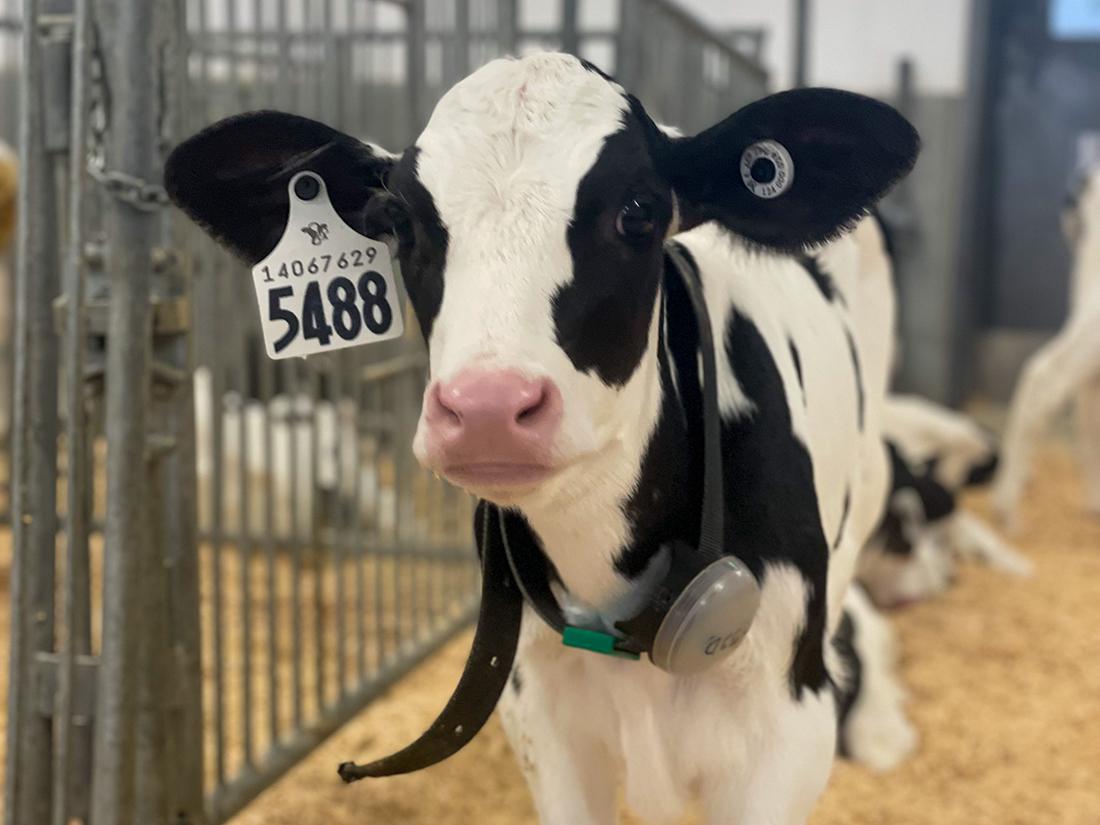 Melissa Cantor, assistant professor of precision dairy science and lead collaborator on a new U.S. National Science Foundation-funded project at Penn State, is a leader on the effort to use modern sensing technologies, like the sensor around this calf’s neck that monitors its wellbeing, and artificial intelligence (AI) to improve animal welfare and producers’ profitability. Credit: Penn State. Creative Commons
<関連情報>
- https://www.psu.edu/news/research/story/ai-enabled-monitoring-system-could-help-keep-dairy-calves-healthy
- https://ieeexplore.ieee.org/document/10168900
牛の呼吸器疾患の早期診断のための機械学習と最適化フレームワーク A Machine Learning and Optimization Framework for the Early Diagnosis of Bovine Respiratory Disease
Enrico Casella; Melissa C. Cantor; Megan M. Woodrum Setser; Simone Silvestri; Joao H. C. Costa
IEEE Access Published:30 June 2023
DOI:https://doi.org/10.1109/ACCESS.2023.3291348
Abstract
Bovine Respiratory Disease (BRD) is an infection of the respiratory tract that is the leading reason for antimicrobial use in dairy calves and represents 22% of calf mortalities. The costs and effects of BRD can severely damage a farm’s economy, since raising dairy calves is one of the largest economic investments, and diagnosing BRD requires intensive and specialized labor that is hard to find. Precision technologies based on the Internet of Things (IoT), such as automatic feeders, scales, and accelerometers, can help detect behavioral changes before outward clinical signs of BRD. Such early detection enables early treatment, and thus faster recovery, with less long term effects. In this paper, we propose a framework for BRD diagnosis, its early detection, and identification of BRD persistency status using precision IoT technologies. We adopt a machine learning model paired with a cost-sensitive feature selection problem called Cost Optimization Worth (COW). COW maximizes prediction accuracy given a budget constraint. We show that COW is NP-Hard, and propose an efficient heuristic with polynomial complexity called Cost-Aware Learning Feature (CALF). We validate our methodology on a real dataset collected from 159 calves during the preweaning period. Results show that our approach outperforms a recent state-of-the-art solution. Numerically, we achieve an accuracy of 88% for labeling sick and healthy calves, 70% of sick calves are predicted 4 days prior to diagnosis, and 80% of persistency status calves are detected within the first five days of sickness.