2025-08-05 東京科学大学
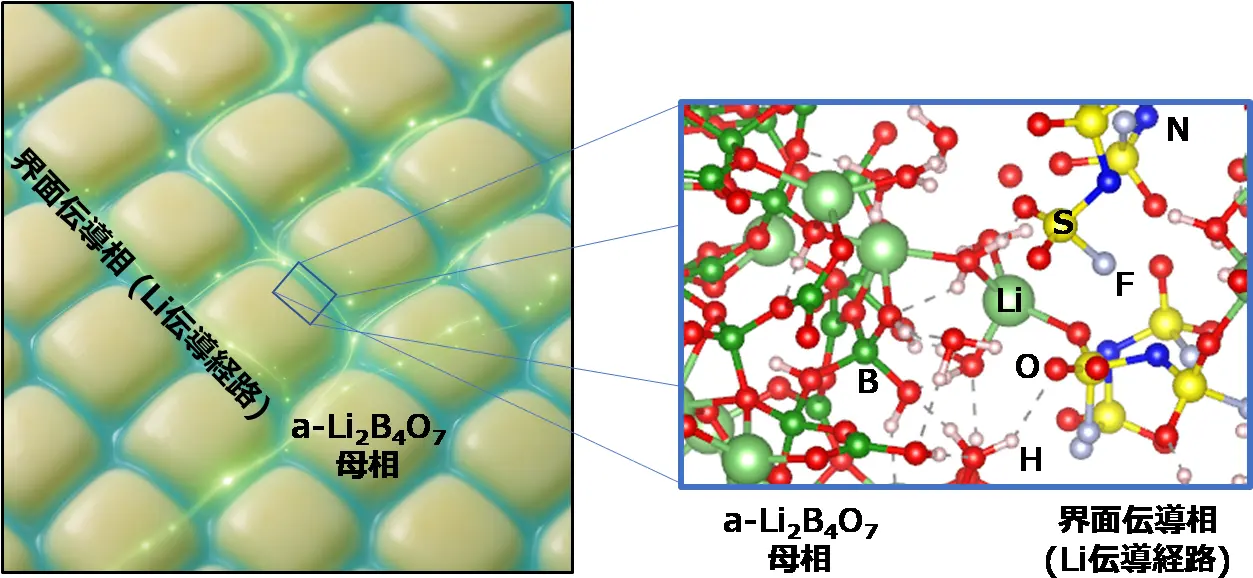
図1. 3D-SLISE(左)1 μm角レベルの模式図、(右)界面の分子構造模式図
<関連情報>
- https://www.isct.ac.jp/ja/news/ibduipkfrzhv
- https://www.isct.ac.jp/plugins/cms/component_download_file.php?type=2&pageId=&contentsId=1&contentsDataId=2053&prevId=&key=5dba92bce715ef11a9b1aaacdc5bee8f.pdf
- https://advanced.onlinelibrary.wiley.com/doi/10.1002/adma.202505649
ホウ酸水ベースの3Dスライム界面準固体電解質を用いたリチウムイオン電池 Borate-Water-Based 3D-Slime Interface Quasi-Solid Electrolytes for Li-ion Batteries
Yosuke Shiratori, Kenta Watanabe, Kengo Saito, Ryota Sato, Yukihiro Okuno, Shintaro Yasui
Advanced Materials Published: 09 July 2025
DOI:https://doi.org/10.1002/adma.202505649
Abstract
The development of solid-state batteries (SSBs) that do not use hazardous materials as electrolytes and are not flammable is progressing rapidly, however the production of sulfide-based SSBs requires strict low-dew-point control due to their high reactivity with atmospheric moisture and the concern of generating hydrogen sulfide, and several issues remain in terms of the cost and recyclability. Thus, low-cost facile materials and low-CO2-emission processes are necessary. With regard to oxide-type SSBs, which are attracting attention for their safety, there are issues with manufacturing suitability, as high-temperature sintering of oxide solid electrolyte particles is required. A new quasi-solid-state (QSS) electrolyte with 3D-ionic conduction and adhesive interfaces by combining amorphous Li2B4O7 and water (3D-Slime Interface Solid Electrolyte: 3D-SLISE) is synthesized without stringent dew point control and sintering. Electrode and electrolyte slurries containing 3D-SLISE are applied to current-collecting foils in air, naturally dried, and used to construct battery laminates. 3D-SLISE-QSSBs (LiCoO2 cathode/3D-SLISE with 7 wt.% bound-water/Li4Ti5O12 or TiNb2O7 anodes) maintain several hundred cycles of charge/discharge as a 2.35 V lithium-ion battery. The 3D-SLISE-QSSB technology can promote the use of safe and low-cost batteries, eliminate the need for a dry room during manufacturing, and enable direct recycling of active materials.