2026-11-12 日本原子力研究開発機構,九州大学
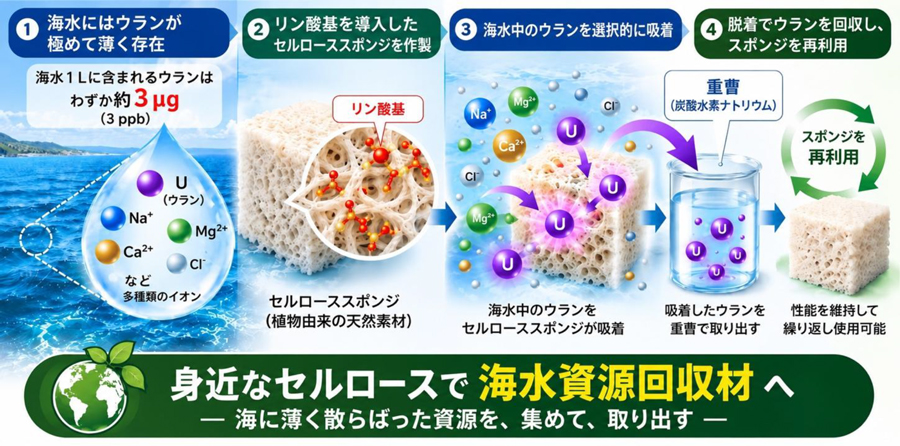
日本原子力研究開発機構(JAEA)と九州大学の研究グループは、植物由来のセルロースを原料とする多孔質スポンジを開発し、海水中のウランを効率的に回収する技術を実証した。海水中のウラン濃度は約3µg/Lと極めて低く、ナトリウム、マグネシウム、カルシウムなどの共存元素が多いため、選択的な回収が課題となっていた。研究では、カルボキシメチルセルロースナノファイバーを凍結架橋法でスポンジ状に加工し、ウランを選択的に吸着するリン酸基を導入した。天然海水を用いた実験では、スポンジ材10mgによって24時間で約99%のウランを吸着し、海水1L当たり0.4gのスポンジを使用した場合も約94%の回収率を達成した。また、重曹水溶液によって吸着したウランの約90%を取り出すことができ、吸着・脱離を3回繰り返しても高い性能を維持した。人工的にウランを添加した水溶液では、スポンジ1g当たり最大約0.3gの吸着容量が推定された。本技術は、再生可能な植物由来材料を用いた低環境負荷型の資源回収技術であり、海水からのウラン資源確保や他の有用元素の回収、環境浄化への応用が期待される。
<関連情報>
リン酸基修飾マクロ多孔質セルローススポンジによる海水からのウラン回収(Phosphate-Functionalized Macroporous Cellulose Sponges for Uranium Recovery from Seawater)
Yurina Sekine, Takuya Nankawa, Asako Sugita, Miki Konda, Makoto Matsueda, Yusuke Beni, Yoko Takahatake, Kayo Yanagisawa, Takahiro Nakanishi, Hikaru Matsumoto, Yoshiko Miura, Hideyuki Yasufuku, Katsuhiko Ariga
ACS Applied Materials & Interfaces 2026-11-11
DOI: 10.1021/acsami.6c18660
Tii-summary
本研究では、海水からウランを効率的に回収するため、リン酸基を導入したマクロ多孔質セルローススポンジを開発した。あらかじめ作製したカルボキシメチルセルロースナノファイバー(CMCF)スポンジに、リン酸二水素アンモニウムと尿素を含浸させ、120℃の穏やかな加熱処理を行うことで、連結した多孔質構造を維持したままリン酸基を導入した。天然海水を用いた実験では、未修飾スポンジのウラン除去性能がほとんど認められなかったのに対し、リン酸化スポンジは24時間以内に約99%のウランを除去した。リン酸基に由来する酸素供与部位がウラン結合に関与し、リン酸基の豊富なセルロース界面にウランが蓄積することも確認された。回収したウランは0.1 mol/Lの炭酸水素ナトリウム水溶液によってほぼ定量的に脱着でき、吸着・脱着を3回繰り返しても性能が維持された。本成果は、簡便な後処理によってセルロース材料にウラン捕集機能を付与する手法を示し、海水からのウラン回収技術の実用化に向けた材料設計に貢献する。
This study developed phosphate-functionalized macroporous cellulose sponges for efficient uranium recovery from seawater. Phosphate groups were introduced into preformed carboxymethyl cellulose nanofiber (CMCF) sponges by impregnation with ammonium dihydrogen phosphate and urea, followed by mild thermal treatment at 120 °C, while preserving the interconnected macroporous architecture. Under natural seawater conditions, the nonphosphorylated sponge exhibited negligible uranium removal, whereas the phosphorylated P1-CMCF sponge removed approximately 99% of uranium within 24 hours. SEM–EDX and XPS analyses supported uranium accumulation at phosphate-rich cellulose interfaces and the involvement of phosphate-associated oxygen donor sites in uranium binding. The captured uranium was almost quantitatively recovered using 0.1 mol/L sodium bicarbonate solution, and adsorption performance was maintained over three adsorption–desorption cycles. These findings demonstrate a simple post-functionalization strategy for producing regenerable cellulose-based adsorbents and offer a promising approach to uranium recovery from chemically complex seawater.
This study developed phosphate-functionalized macroporous cellulose sponges for efficient uranium recovery from seawater. Phosphate groups were introduced into preformed carboxymethyl cellulose nanofiber (CMCF) sponges by impregnation with ammonium dihydrogen phosphate and urea, followed by mild thermal treatment at 120 °C, while preserving the interconnected macroporous architecture. Under natural seawater conditions, the nonphosphorylated sponge exhibited negligible uranium removal, whereas the phosphorylated P1-CMCF sponge removed approximately 99% of uranium within 24 hours. SEM–EDX and XPS analyses supported uranium accumulation at phosphate-rich cellulose interfaces and the involvement of phosphate-associated oxygen donor sites in uranium binding. The captured uranium was almost quantitatively recovered using 0.1 mol/L sodium bicarbonate solution, and adsorption performance was maintained over three adsorption–desorption cycles. These findings demonstrate a simple post-functionalization strategy for producing regenerable cellulose-based adsorbents and offer a promising approach to uranium recovery from chemically complex seawater.