2026-11-11 富山大学
<関連情報>
長期にわたる共有社会経済経路に対する数世紀にわたる海洋生物地球化学的応答 Multi-centennial ocean biogeochemical responses to extended Shared Socioeconomic Pathways
Hidetaka Kobayashi, Tokuta Yokohata, Akitomo Yamamoto, Tomohiro Hajima, Hiroaki Tatebe, Akira Oka, and Keith B. Rodgers
Biogeosciences Published:11 Nov 2026
DOI:https://doi.org/10.5194/bg-23-7807-2026
Abstract
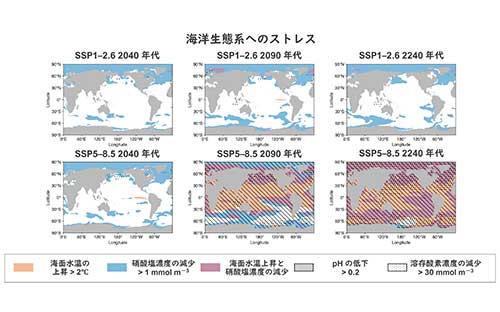
Despite their profound consequences for the global carbon cycle, multi-centennial ocean biogeochemical responses to anthropogenic greenhouse gas forcing remain poorly constrained. Here we investigate long-term oceanic responses to atmospheric CO2 forcing using the Model for Interdisciplinary Research on Climate, Earth System version 2 for Long-term simulations (MIROC-ES2L) Earth system model driven by extended Shared Socio-economic Pathway (SSP) scenarios through to the year 2500. Ocean–atmosphere pCO2 disequilibrium exhibits strong scenario dependence. Under the low-emission scenario SSP1–2.6, oceanic CO2 undersaturation gradually weakens and approaches near equilibrium by 2100. By contrast, under the high-emission scenario SSP5–8.5, rapid increase in atmospheric pCO2 results in increasing undersaturation of CO2 in the ocean over the 21st century. Thereafter, surface-ocean CO2 supersaturation progressively expand into the equatorial and subtropical oceans between the mid–23rd and late 25th century. The Southern Ocean remains persistently undersaturated throughout the simulations, consistent with sustained influence from deep waters that are weakly affected by anthropogenic perturbations. Under SSP5–8.5, oceanic CO2 uptake continues to increase until the late 21st century. Thereafter, it gradually weakens as surface-ocean pCO2 approaches atmospheric levels, whereas the Southern Ocean remains a persistent carbon sink throughout the simulation. Across all scenarios, early oceanic pCO2 changes are primarily driven by increases in dissolved inorganic carbon, whereas alkalinity becomes an increasingly important control from the mid–22nd century onward under SSP5–8.5. A progressive decline in the oceanic CO2 buffering capacity, driven by cumulative CO2 uptake, increases the sensitivity of surface-ocean pCO2 to additional carbon uptake. The buffering capacity approaches its effective minimum levels by the late 22nd century. In parallel, enhanced upper-ocean stratification and a slowdown of the deep overturning circulation reduce the upward transport of high alkalinity waters to the surface. This results in a decline in surface-ocean alkalinity that further enhances the influence of alkalinity on surface-ocean pCO2 during this period. Marine biological productivity and export vary significantly as a function of atmospheric CO2 trajectory. It increases under low-emission scenarios but declines under sustained high-emission scenarios. The transition between the two behaviors occurs when pCOatm2 reaches approximately 3 times the preindustrial level and is closely associated with the weakening of the Atlantic Meridional Overturning Circulation and the resulting nutrient redistribution. Thermal stress and nutrient limitation persist in regions such as the Arctic Ocean until the late 25th century even under SSP1–2.6, indicating a centennial-scale lagged response of marine ecosystems to atmospheric CO2 forcing. In the surface ocean, marine ecosystem stress (integrating thermal and biogeochemical stressors) continues to intensify through the late 22nd century under SSP5–8.5, despite the stabilization of atmospheric pCO2, highlighting the long memory and limited reversibility of oceanic ecosystem stress.