2026-11-04 水産研究・教育機構,大阪府立環境農林水産総合研究所,兵庫県立農林水産技術総合センター,和歌山県水産試験場,岡山県農林水産総合センター,広島県立総合技術研究所,山口県水産研究センター,徳島県農林水産総合技術支援センター,香川県水産試験場,愛媛県農林水産研究所,福岡県水産海洋技術センター,大分県農林水産研究指導センター
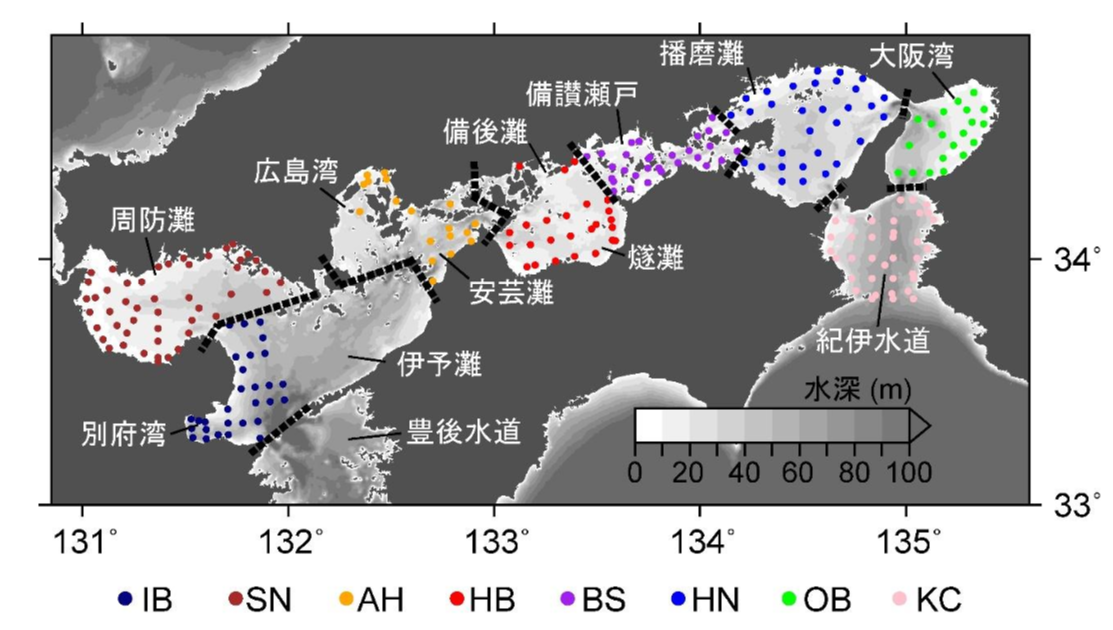
図1.瀬戸内海ブロック浅海定線調査の観測点と海域区分(IB:伊予灘西部・別府湾、SN:周防灘、AH:安芸灘・広島湾、HB:燧灘・備後灘、BS:備讃瀬戸、HN:播磨灘、OB:大阪湾、KC:紀伊水道)
<関連情報>
- https://www.fra.go.jp/home/kenkyushokai/press/pr2026/20261104_press_seto-inland-sea.html
- https://www.fra.go.jp/home/kenkyushokai/press/pr2026/files/20261104_press_seto-inland-sea.pdf
- https://link.springer.com/article/10.1007/s10872-026-00813-y
瀬戸内海における水質の長期的な変化:53年間の観測(1973年~2025年) Long-term changes in water quality in the Seto Inland Sea, Japan: 53-year observations (1973–2025)
Goh Onitsuka, Satoshi Akiyama, Shota Higo, Toyoho Gosho, Genki Inui, Masayuki Kagawa, Toshiteru Watanabe, Masahiro Kayano, Youko Ishikawa, Makoto Yoshida, Hirotaka Kiyasu, Hiroki Maki, Osamu Ezaki, Masato Okada & Ayaka Mouri
Journal of Oceanography
DOI:
Abstract
We analyzed 53 years (1973–2025) of water quality observations collected through the Fisheries Monitoring Program in the Seto Inland Sea (SIS), one of the longest-standing coastal monitoring efforts in Japan. Using climatological anomalies and non-parametric statistical tests, we quantified long-term trends and significant change points in water temperature, salinity, transparency, dissolved oxygen (DO), and dissolved inorganic nitrogen and phosphorus (DIN and DIP) across the SIS. Water temperature exhibited significant long-term increases in both surface and bottom layers (+ 1.25 °C 50-yr⁻1 and +1.03 °C 50-yr⁻1, respectively), with widespread shifts occurring in the mid-1990s, indicating basin-wide warming linked to atmospheric and offshore ocean conditions. Surface salinity showed basin-wide downward shifts around 2010, particularly in the central SIS. Transparency increased markedly over the study period, especially in the eastern SIS, consistent with long-term declines in nutrient concentrations. Trends in bottom-layer DO varied regionally: long-term increases were detected in Beppu Bay and Osaka Bay, whereas declining or non-significant trends characterized other regions. DIN concentrations decreased substantially after the late 1990s, particularly in the eastern SIS, while DIP showed large reductions from the 1970s to the 1980s followed by stabilization or increases in western regions. Although long-term and basin-wide impacts of anthropogenic activities remain substantial, the rates of nutrient declines were not proportional to reductions in land-based loading, reflecting the influence of biogeochemical processes and multiple nutrient sources. Our study reveals substantial climatic and anthropogenic impacts on the SIS and provides essential baseline information for fisheries resource assessment and adaptive coastal management.