2026-11-04 中国科学院(CAS)
<関連情報>
- https://english.cas.cn/newsroom/research-news/202611/t20261103_1213054.shtml
- https://academic.oup.com/icesjms/article/83/10/fsag210/8965167
マグロの種類によって、地中海の生息地の適性や気候変動下での環境へのアクセス性が異なる Tuna species differ in Mediterranean habitat suitability and environmental accessibility under climate change
Shengyu Xiang, Gabriel Reygondeau, Cui Liang , Hui Zhang
ICES Journal of Marine Science Published: 21 October 2026
DOI:https://doi.org/10.1093/icesjms/fsag210
Abstract
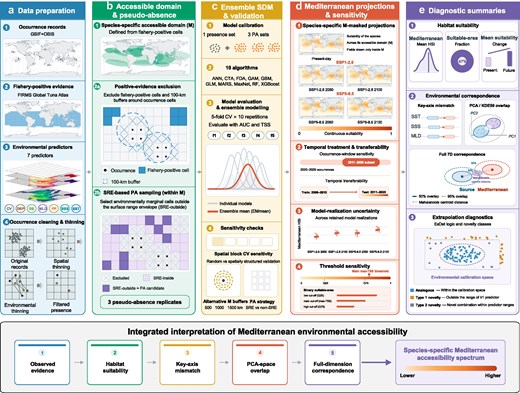
Climate change is reshaping the distributions of highly migratory marine predators, yet projected habitat suitability does not necessarily indicate ecological accessibility or recurrent use. This distinction is particularly important in the rapidly warming Mediterranean Sea, where occurrence and fishery-positive evidence are available for several tuna species but comparative accessibility assessments remain limited. We assessed environmental accessibility to the Mediterranean for five tuna species with contrasting regional associations. We combined occurrence records, fishery-positive evidence, species-specific accessible domains, ensemble species distribution models, and multidimensional environmental-space diagnostics under present-day and future climate scenarios. Present-day projections indicated broad Mediterranean suitability for albacore and Atlantic bluefin tuna, but more restricted suitability for yellowfin tuna, bigeye tuna, and skipjack tuna. Under late-century high-emission warming, suitable areas expanded for tropical-associated tunas, whereas Atlantic bluefin tuna contracted markedly. However, environmental-space diagnostics showed that suitability gains did not consistently translate into stronger environmental correspondence or accessibility. Tropical-associated species remained weakly aligned with Mediterranean environments because of persistent salinity mismatch, altered mixed-layer structure, and large multivariate distances between Mediterranean and occurrence-associated environmental conditions. These findings show that the Mediterranean represents a species-specific accessibility spectrum rather than a uniformly opening basin. By separating habitat suitability from environmental correspondence, this study provides a fisheries-oceanographic perspective for interpreting climate-driven tuna habitat shifts and assessing whether marginal marine systems are becoming ecologically accessible under future ocean conditions.