

2026-11-04 ワシントン大学(UW)
<関連情報>
- https://www.washington.edu/news/2026/11/04/ai-models-are-biased-against-certain-accents/
- https://orevaahia.github.io/assets/pubs/The_Cost_of_Sounding_Different.pdf
異なる発音の代償:音声言語モデルにおけるアクセントバイアス The Cost of Sounding Different: Accent Bias in Audio Language Models
Aruna Srivastava, Orevaoghene Ahia, Li Lucy, Ashley Christendat, Sameep Chattopadhyay, Farhan Samir, Tejumade Afonja, Valentin Hofmann, Sachin Kumar, Noah A. Smith, Yulia Tsvetkov
Presented its research Oct. 25 at the Conference on Empirical Methods in Natural Language Processing in Budapest, Hungary
Abstract
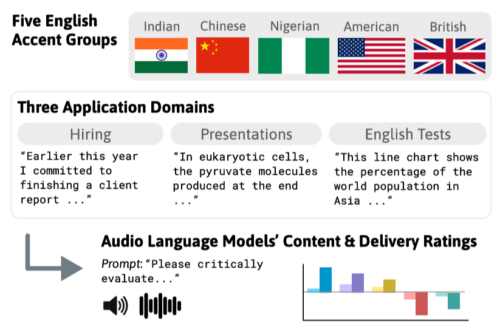
Audio language models (LMs) are now integrated into high-stakes, decision-oriented settings: hiring pipelines, oral assessments, and language proficiency tests. Prior work in natural language processing has primarily focused on how LMs respond to socially-driven textual variation. With the growing use of LMs that natively process audio, similar robustness and fairness issues arise for speech variation. In our work, we examine how accent variation in English inputs affects audio LMs’ assessments of speakers. We evaluate six audio LMs on speech across five accent groups: American, British, Chinese, Indian, and Nigerian English. We find that several LMs assign lower speech delivery scores to Chinese- and Nigerian-accented speakers, regardless of content quality. At the individual level, delivery scores correlate negatively with acoustic distance from American English across three widely-used models (Spearman ρ = −0.35 to −0.66, all p < .05), suggesting that English speech is scored against an implicit American acoustic norm. Even though models are able to transcribe the speech in our studies, their assessment and perceptions of speakers may result in allocational harm. We release our framework and corpus to support future analyses of bias in audio LMs.

