2026-11-04 東京大学,産業技術総合研究所,Khalifa University of Science and Technology,UCLouvain
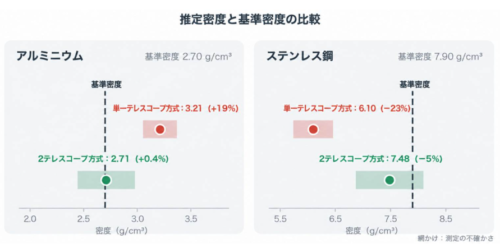
図1:横並びに配置した2台のミュオンテレスコープを用いて得られた、アルミニウムおよびステンレス鋼ブロックの測定密度と基準密度との比較
<関連情報>
- https://www.k.u-tokyo.ac.jp/information/category/press/0030697.html
- https://www.nature.com/articles/s42005-026-02921-z
吸収性ミューオグラフィーにおける密度推定精度向上のためのリアルタイムデュアルテレスコープ正規化 Real-time dual-telescope normalization for improved density estimation in absorption muography
Hamid Basiri, Jun Matsushima, Masashi Kodama, Toshiyuki Yokota, Mohammed Y. Ali, Fateh Bouchaala, Ahmed Eleslambouly, Hiroyuki K. M. Tanaka, Eduardo Cortina Gil & Andrea Giammanco
Communications Physics Published:02 November 2026
DOI:https://doi.org/10.1038/s42005-026-02921-z
Abstract
Absorption muography infers path-averaged density from the attenuation of atmospheric muons. Transient flux variations driven by weather, solar activity, and geomagnetism bias sequential measurements that rely on a non-simultaneous background. Here we show a real-time dual-telescope normalization in which two identical plastic-scintillator telescopes operate in parallel, one viewing open sky as a reference and one viewing the target. Their count-rate ratio cancels common-mode flux changes and tracks detector drift. A 140-h no-target run yields a stable calibration, and stacked acrylic slabs give an empirical transmission–thickness curve. Applied to blind targets, the dual-telescope workflow recovers the densities of 20-cm aluminum and 10-cm stainless-steel blocks within uncertainties, whereas a single-telescope workflow shows systematic biases of +18.95% and −22.82%. A vertical stack of the two telescopes further improves common-mode rejection, reducing calibration ratio scatter from 7.6% to 3.3%. The method is model-independent, removes systematic density biases in any campaign where a simultaneous flux reference is feasible, and is directly applicable to field deployments.