2026-10-26 東北大学
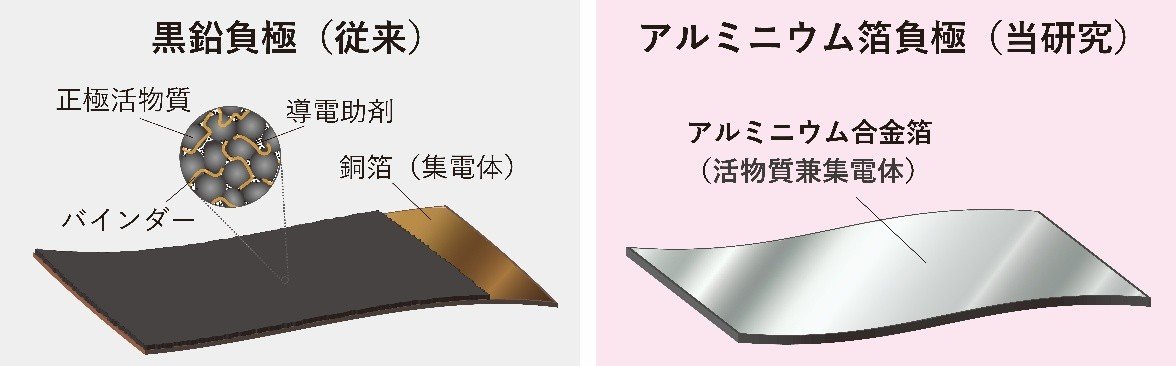
図 1.従来の黒鉛負極とアルミニウム箔負極の比較。
<関連情報>
- https://www.tohoku.ac.jp/japanese/2026/10/press20261026-01-aluminum.html
- https://www.nature.com/articles/s43246-026-01377-6
マンガン合金化による充電式リチウム電池用アルミ箔負極における脱リチウム化のボトルネックの解消 Breaking the delithiation bottleneck in aluminum-foil anodes for rechargeable lithium batteries by Mn alloying
Yuki Nakata, Hongyi Li, Weiqi Liu, Shingo Matsumoto, Tomohiro Hayashi, Takafumi Yoshinaga, Yoshiaki Honda, Toshiaki Kumagai, Hiroaki Hoshikawa, Takitaro Yamaguchi & Tetsu Ichitsubo
Communications Materials Published:23 October 2026
DOI:https://doi.org/10.1038/s43246-026-01377-6
Abstract
Aluminum foil anodes are attractive for rechargeable lithium batteries because they combine the functions of active material and current collector. However, once Li is removed from lithiated Al, a Li-depleted Al layer rapidly forms at the surface and impedes further Li extraction from deeper regions; this often forces delithiation to proceed through cracking and pore formation, which accelerates passivation and irreversible capacity loss. Here, we show that Mn alloying resolves this bottleneck. Mn remains dissolved in the fcc-Al matrix and locally hinders Li migration, suppressing the growth of lithiated Al domains to form a refined Al/LiAl microstructure. Simultaneously, Mn mitigates the intrinsic diffusion asymmetry between Li and Al within the LiAl phase. Consequently, the synergy of shortened diffusion distances, numerous grain boundaries acting as fast-transport pathways, and balanced atomic transport enables dense deep delithiation without destructive porous evolution. Ultimately, Al–Mn foil anodes achieve improved cycle life without sacrificing initial Coulombic efficiency, thereby providing an Al-foil-anode design strategy.