2026-10-22 東北大学
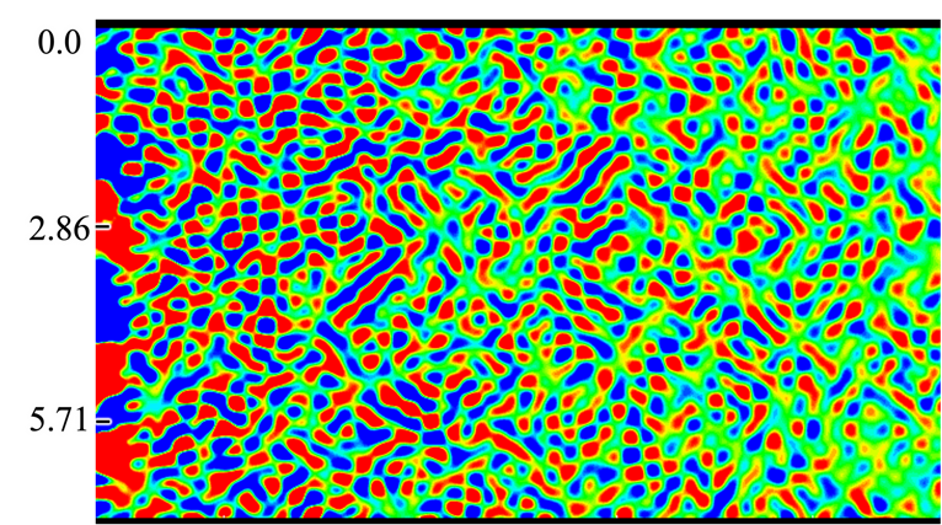
図1. 遷移が始まる直前の壁面近傍に現れた、約45度に傾いた周期的な流れ構造。波長は境界層厚さの0.35〜0.55倍である。
<関連情報>
- https://www.tohoku.ac.jp/japanese/2026/10/press20261022-01-coherent.html?utm_source=chatgpt.com
- https://www.sciencedirect.com/science/article/pii/S0997754626002037
遷移境界層の壁面近傍における新たなコヒーレント流構造 New coherent flow structure near a wall in the transitional boundary layer
Aiko Yakeno
European Journal of Mechanics – B/Fluids Available online: 16 October 2026
DOI:https://doi.org/10.1016/j.euromechflu.2026.204656
Abstract
This study identifies and characterizes a coherent flow structure that has not previously been characterized in detail, residing extremely close to the wall in a flat-plate boundary layer undergoing laminar-to-turbulent transition. High-resolution direct numerical simulations (DNS) reveal the structure within the innermost 14.3% (≤0.143) of the inlet boundary layer thickness, with streamwise and spanwise wavelengths in the range 0.35–0.55, one to two orders of magnitude smaller than those of any known transitional flow structure at the same Reynolds number. The structure is characterized by a 45-degree oblique spanwise velocity pattern, correlated negative pressure and streamwise velocity fluctuations, and alternating wall-normal velocity fluctuations. Its spatial scale and orientation are robust across different forcing conditions, grid resolutions, and Mach numbers (=0.1–0.3), confirming a physical origin rather than a numerical artefact. Orr–Sommerfeld analysis rules out Tollmien–Schlichting wave instability as the origin. Numerical filtering tests show that suppressing near-wall fluctuations in this region weakens downstream turbulent vortex structures, suggesting that the structure participates in the transitional process. Comparisons with linear transient growth analysis indicate that short-target-time parallel modes yield wavelengths consistent with the DNS observations, suggesting a possible connection to non-modal amplification, although a definitive causal explanation requires further investigation. These results contribute to the understanding of early-stage transition mechanisms and point to potential targets for near-wall flow control strategies.