
2026-08-04 東北大学
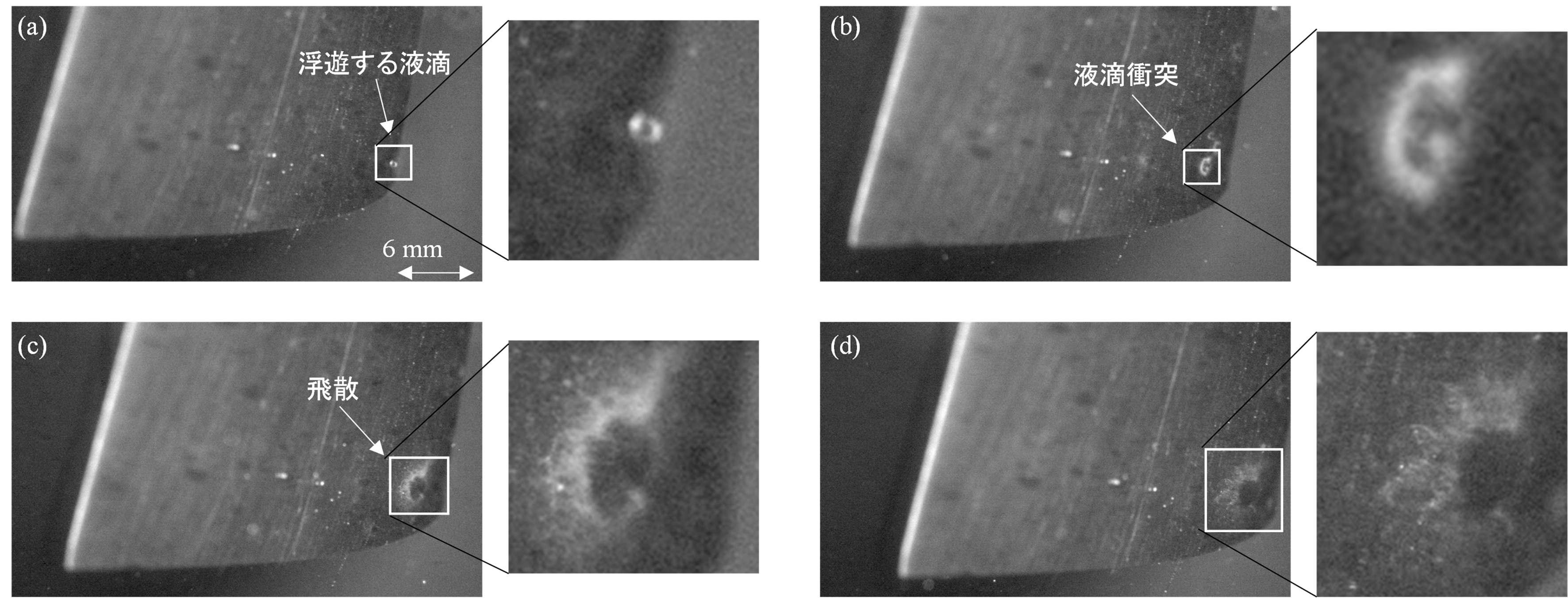
1. 高速回転する地熱タービン動翼への液滴衝突・飛散の様子。
<関連情報>
- https://www.tohoku.ac.jp/japanese/2026/08/press20260804-02-turbine.html
- https://link.springer.com/article/10.1007/s00348-026-04273-4
地熱タービンバケット上の液滴の飛散と軌跡の可視化、および液滴の動きの理論的予測 Visualization of droplet splashing and droplet trajectory and theoretical prediction of a droplet motion on the geothermal turbine bucket
Ippei Oshima,Mikito Furuichi,Yuya Nakashima & Masahiro Sato
Experiments in Fluids Published:03 August 2026
DOI:https://doi.org/10.1007/s00348-026-04273-4
Abstract
Understanding liquid behavior on the surface of rapidly rotating turbine blades is essential for clarifying drain formation in wet-steam turbines. However, direct experimental visualization of droplet impact and subsequent liquid transport under the combined conditions of ultra-high peripheral velocity and low ambient pressure has not been reported. In this study, we present high-speed visualization of droplet impact and liquid transport on an actual turbine bucket at peripheral velocities of 30–430 m/s under ambient pressures of 1–5 kPa. The results show that prompt splashing occurs even in this low-pressure regime, contrary to splash-suppression trends reported for lower-impact velocity and non-rotating conditions. Impinging droplets form thin films, ligaments, and droplet trains on the surface; despite their different morphologies, these liquid phases exhibit similar transport characteristics governed by the balance between centrifugal and Coriolis forces. At the bucket tip, accumulated liquid is stretched by centrifugal force and undergoes Rayleigh breakup, with the resulting droplet diameter decreasing systematically with increasing rotational speed. A minimal numerical model incorporating centrifugal, Coriolis, and effective interfacial resistance qualitatively reproduces the observed liquid transport trajectories on the actual bucket geometry. These combined experimental visualizations and numerical modeling provide a consistent physical description on rapidly rotating surfaces under low-pressure, ultra-high-speed conditions, and offer a basis for understanding drain-related loss mechanisms in wet-steam turbines.
