2026-10-21 ロイヤルメルボルン工科大学(RMIT)
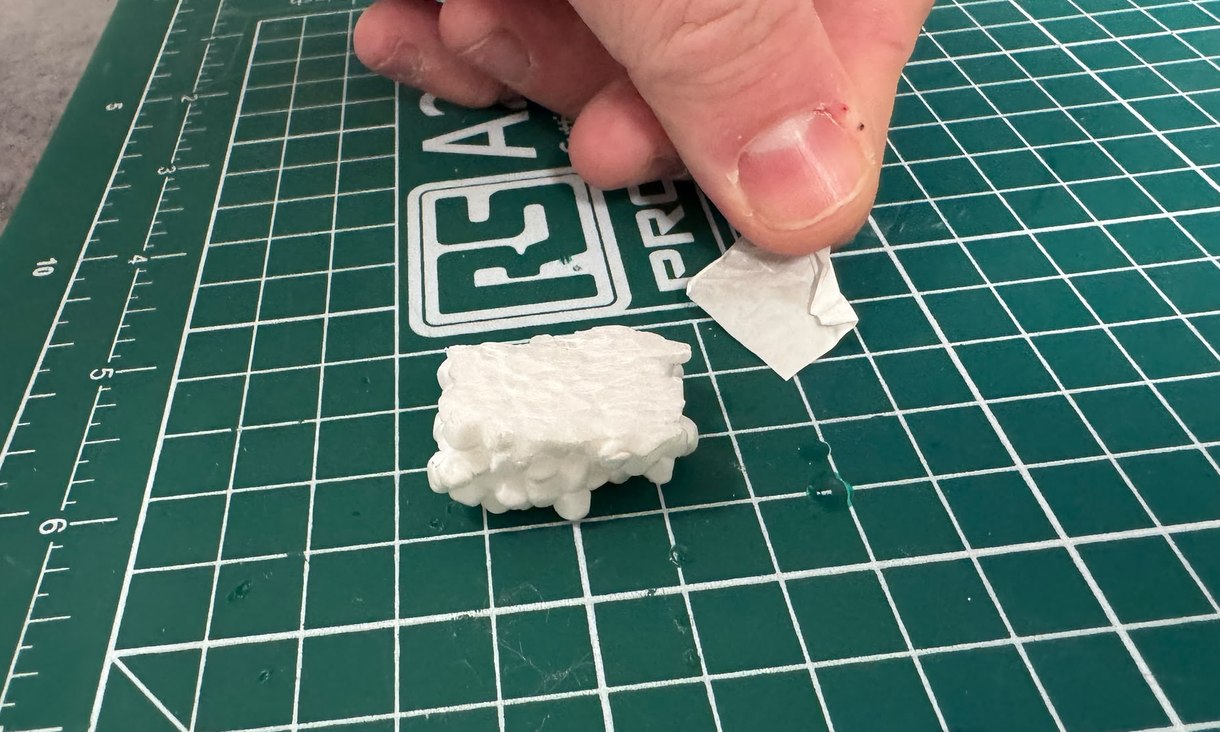
A polystyrene block and a thin polystyrene layer used in the team’s static charge demonstration. Credit: Will Wright, RMIT University
<関連情報>
- https://www.rmit.edu.au/news/all-news/2026/oct/static-charge-programming
- https://www.nature.com/articles/s41467-026-77733-4
接触・摩擦・分離過程における静電荷は、電場によって制御される Electric fields control static charge during contact-friction-separation
Andris Šutka, Linards Lapčinskis, Artis Linarts, Qiang Sun, Janis Lungevics, Raivis Eglītis, Māris Knite, Dumindu G. Dassanayaka, Amanda V. Ellis & Peter C. Sherrell
Nature Communications Published:15 October 2026
DOI:https://doi.org/10.1038/s41467-026-77733-4
Abstract
Contact electrification occurs when two materials rub against one another. This is either a problem, such as when charge builds up during powder processing, or an exploited phenomenon to harvest energy, as is the case in triboelectric nanogenerators. However, why contact electrification occurs remains a topic of hot debate, with ions, adsorbates, electrons and combinations thereof being ascribed the charge carriers. Irrespective of the charge carrier however, there must be a driving force inducing charge to separate and move from one surface to another. Herein, we demonstrate that electric fields, either applied externally or spontaneously generated at an interface can completely alter and even invert surface charge measured after contact electrification in polymer-polymer contact. Applying an external electric field allows the direct control of both magnitude and polarity static charge on dielectric polymers. These results are coupled to simulations that show the applied electric field is on the order of the fields generated by the flexoelectric effect – providing prima facie evidence of flexoelectric driven contact electrification.