2026-10-16 東京科学大学
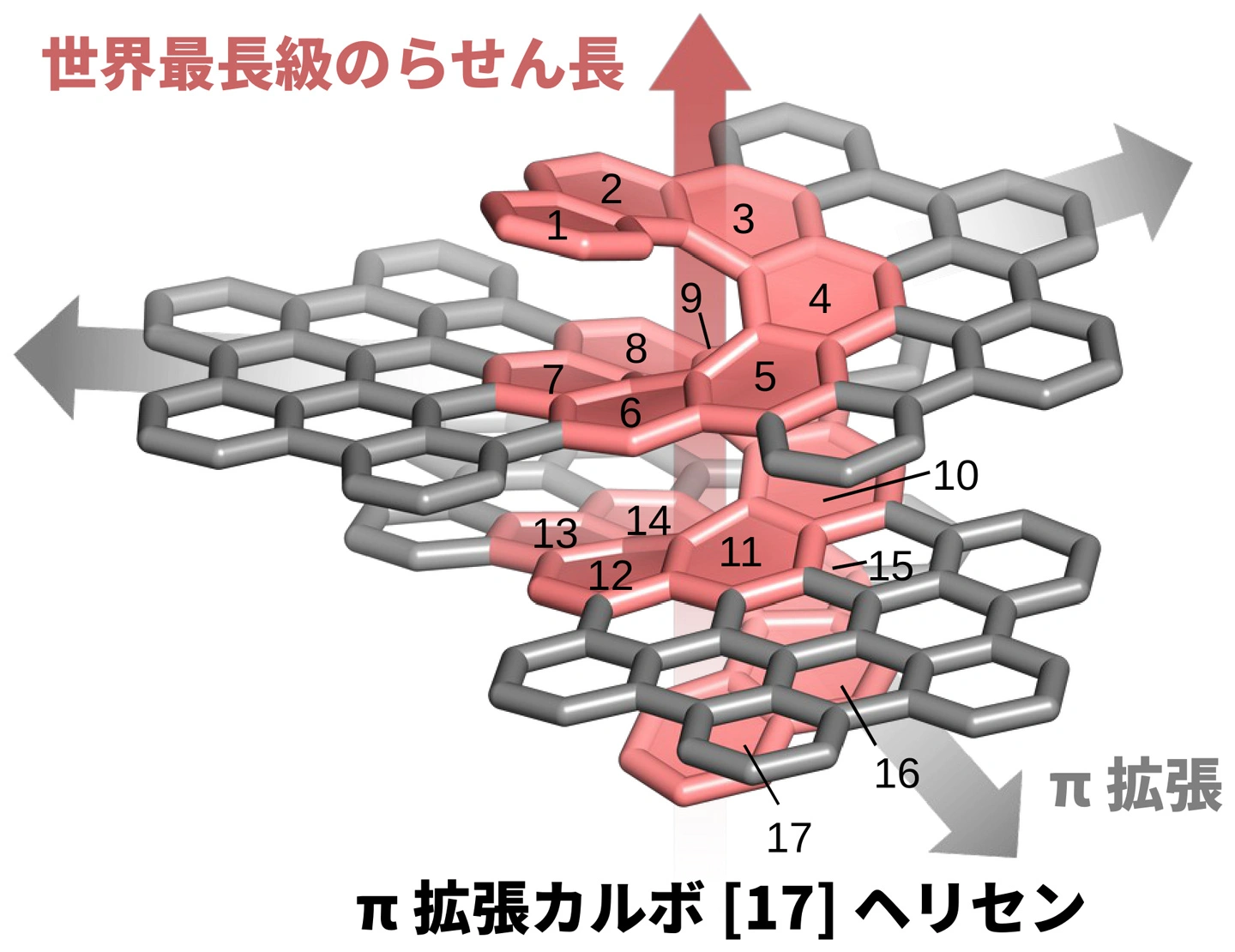
世界最長級のπ拡張カルボ[17]ヘリセン
<関連情報>
配列制御された四重[2+2+2]環化付加反応によるπ拡張カルボ[17]ヘリセンの鏡像選択的合成 Enantioselective synthesis of π-extended carbo[17]helicene via sequence-controlled quadruple [2+2+2] cycloadditions
Futo Morita, Takeshi Ichimura, Juntaro Nogami, Yuko Kishida, Kanato Takahashi, Ryota Shimizu, Hidehiro Uekusa & Ken Tanaka
Nature Synthesis Published:14 October 2026
DOI:https://doi.org/10.1038/s44160-026-01193-3
Abstract
The enantioselective synthesis of giant chiral nanocarbons composed solely of carbon and hydrogen remains a central synthetic challenge. Increasing molecular strain, steric congestion and loss of cyclization sequence control have prevented access to enantioenriched long π-extended carbohelicenes. Here we report the enantioselective synthesis of a π-extended carbo[17]helicene enabled by a programmed precursor for quadruple [2+2+2] cycloadditions followed by oxidative annulations. The sterically differentiated dodecayne incorporates two inner triyne units forming less congested [5]helicenes and two outer triyne units forming sterically demanding [6]helicenes. These triyne units are separated by a triphenylene backbone that modulates steric demand and enforces sequence from the molecular centre. This sequence-controlled annulation suppresses dead-end pathways and enables stepwise assembly of the helicene framework with high enantioselectivity. The resulting carbohelicene exhibits circularly polarized luminescence with glum values of up to 0.043. This study highlights steric differentiation and cyclization programming as useful design strategies for the enantioselective synthesis of large helical nanocarbons.