
2026-10-13 カリフォルニア大学サンディエゴ校(UCSD)
<関連情報>
- https://today.ucsd.edu/story/jamming-flow-to-enable-memory-in-quantum-materials
- https://www.nature.com/articles/s41467-026-76844-2
金属-絶縁体スイッチングにおける妨害制御された確率性 Jamming-controlled stochasticity in metal-insulator switching
Nicolò D’Anna, Nareg Ghazikhanian, Katherine Matthews, Daseul Ham, Su Yong Lee, Alex Frano, Ivan K. Schuller & Oleg G. Shpyrko
Nature Communications Published:24 September 2026
DOI:https://doi.org/10.1038/s41467-026-76844-2 Early provide
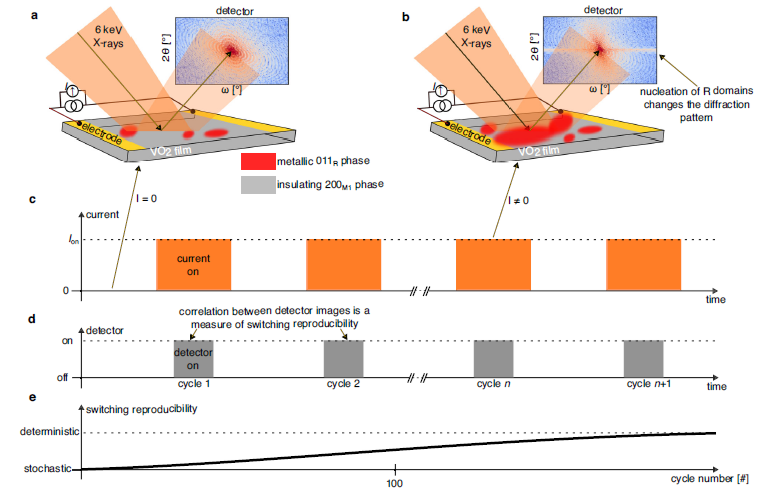
Fig. 1 | X-ray diffraction and electrical setup.
Abstract
Understanding and controlling phase transitions is fundamental to physics and central to many technological revolutions. There is currently strong interest in materials with coupled structural and electronic phase transitions, where controlling the transition plasticity naturally yields built-in memory, key for emulating neurons and synapses in neuromorphic technologies. Here, operando coherent Bragg X-ray diffraction is used to study the evolution of the nano-domain distribution at the micron-scale in neuromorphic devices made from the archetypal Mott insulator vanadium dioxide. Electrical switching leads to nano-domain reconfiguration over thousands of seconds and a jamming transition. Repetitive above-threshold currents plastically drive the system into a jammed/glassy state where switching is deterministic. Sub-threshold currents erase the short-term memory defined by the nano-domain distribution, recovering stochastic switching, thus offering a path for in-device learning. These results highlight the importance of nanoscale physics in phase transitions, even for macroscopic devices, and offer guidance for future device operation.

