2026-09-29 カリフォルニア大学リバーサイド校(UCR)
<関連情報>
- https://news.ucr.edu/articles/2026/09/29/how-ocean-chemistry-helped-life-keep-breathing
- https://www.nature.com/articles/s41467-026-76597-y
地球の大酸化期における酸素化ダイナミクスに対する栄養素の制御 A nutrient control on oxygenation dynamics during Earth’s Great Oxidation Episode
Lewis J. Alcott, Benjamin J. W. Mills, Andrey Bekker, Zidong Peng & Simon W. Poulton
Nature Communications Published:27 August 2026
DOI:https://doi.org/10.1038/s41467-026-76597-y
Abstract
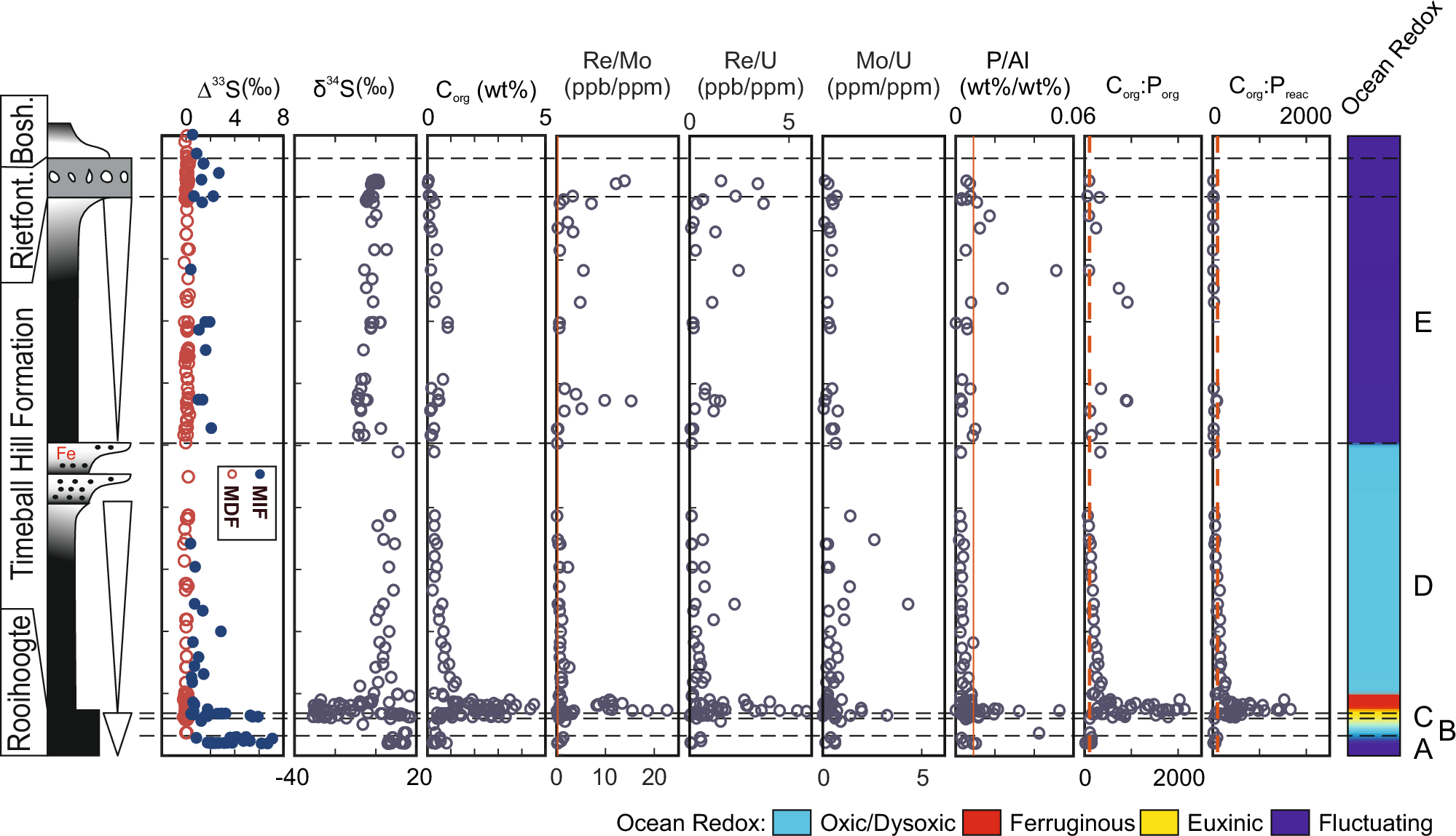
Earth’s first rise in atmospheric oxygen occurred over a protracted period from ca. 2.43 to 2.06 billion years ago during the Great Oxidation Episode (GOE). The GOE was marked by extreme climatic instability, which likely impacted the bioavailability of the principal limiting nutrient, phosphorus. Here, we investigate phosphorus cycling across the final two glaciations of the GOE, as documented by the Transvaal Supergroup, South Africa. Utilising a phosphorus phase partitioning approach, we show that following an enhanced weathering-induced phosphorus influx that stimulated oxygenation in the aftermath of glaciation, sedimentary phosphorus recycling was controlled by feedback-driven fluctuations in sulphate availability and oceanic redox state. Biogeochemical modelling suggests that this dynamic interplay drove major instability in atmospheric oxygen levels during Earth’s protracted transition to a persistently oxygenated atmosphere.