2026-09-24 ローレンス・バークレー国立研究所(LBNL)
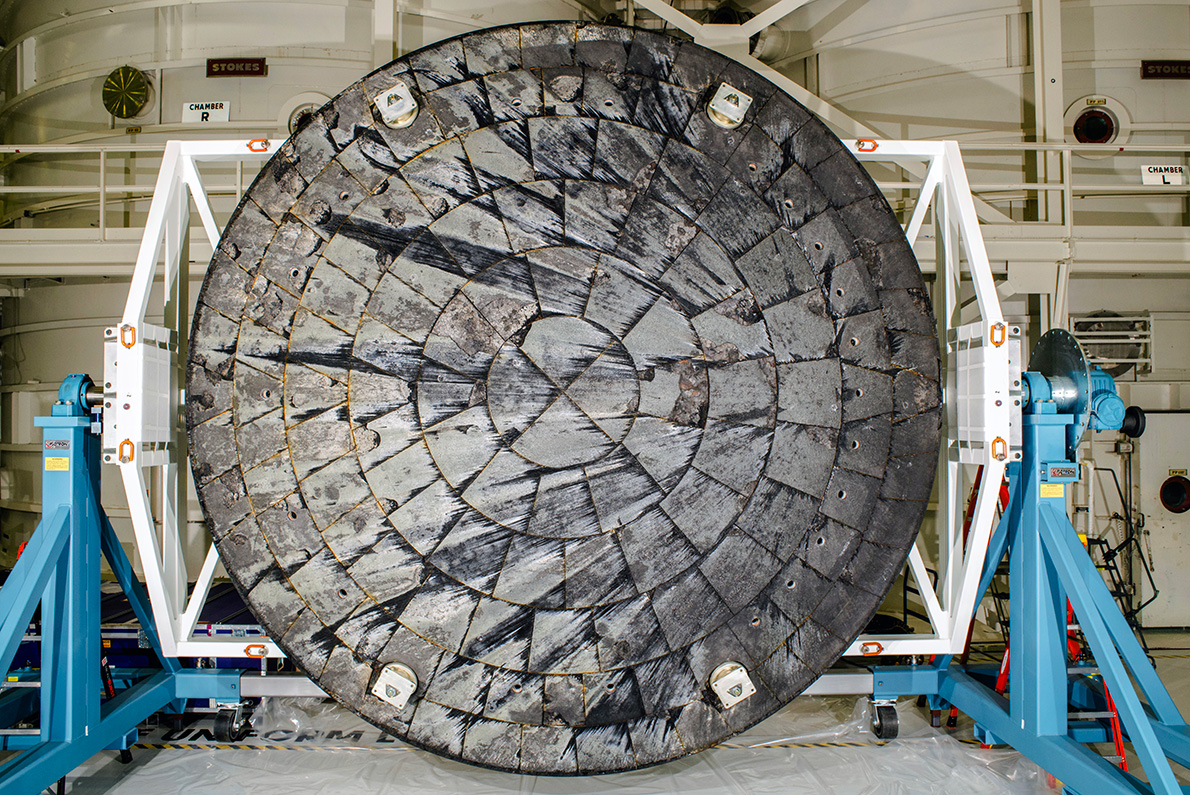
A heat shield removed from NASA’s Orion spacecraft and inspected following the Artemis I test flight. (Credit: NASA)
<関連情報>
- https://newscenter.lbl.gov/2026/09/24/scientists-get-real-time-look-inside-spacecraft-heat-shields-during-extreme-heat-conditions/
- https://www.nature.com/articles/s41529-025-00556-z
熱分解する超軽量アブレーション材の超解像微細構造 Super-resolved microstructure of pyrolyzing superlight ablators
Collin W. Foster, Sreevishnu Oruganti & Francesco Panerai
npj Materials Degradation Published:05 February 2025
DOI:https://doi.org/10.1038/s41529-025-00556-z
Abstract
The microstructural evolution of superlight ablators during pyrolysis was investigated using in situ X-ray micro-computed tomography and generative adversarial networks. Superlight ablators, a type of syntactic foam thermal protection materials, are commonly employed in the backshells of planetary entry probes. Synchrotron X-rays were used to resolve the material constituents during thermal degradation, including resin, silica microballoons, cork filler, refractory fibers, and voids. A super-resolution methodology was implemented, where high-resolution tomography scans were applied to denoise, segment and analyze lower-resolution in situ datasets that captured a large field of view. This multi-scale approach enabled the quantification of morphological and effective properties as a function of temperature during degradation, while also relating these changes to relevant decomposition chemistry. This study demonstrates a strategy for time-resolving rapid, multiphase decomposition events occurring under high-temperature test environments that mimic atmospheric entry.