2026-09-21 合肥物質科学研究院(HFIPS)
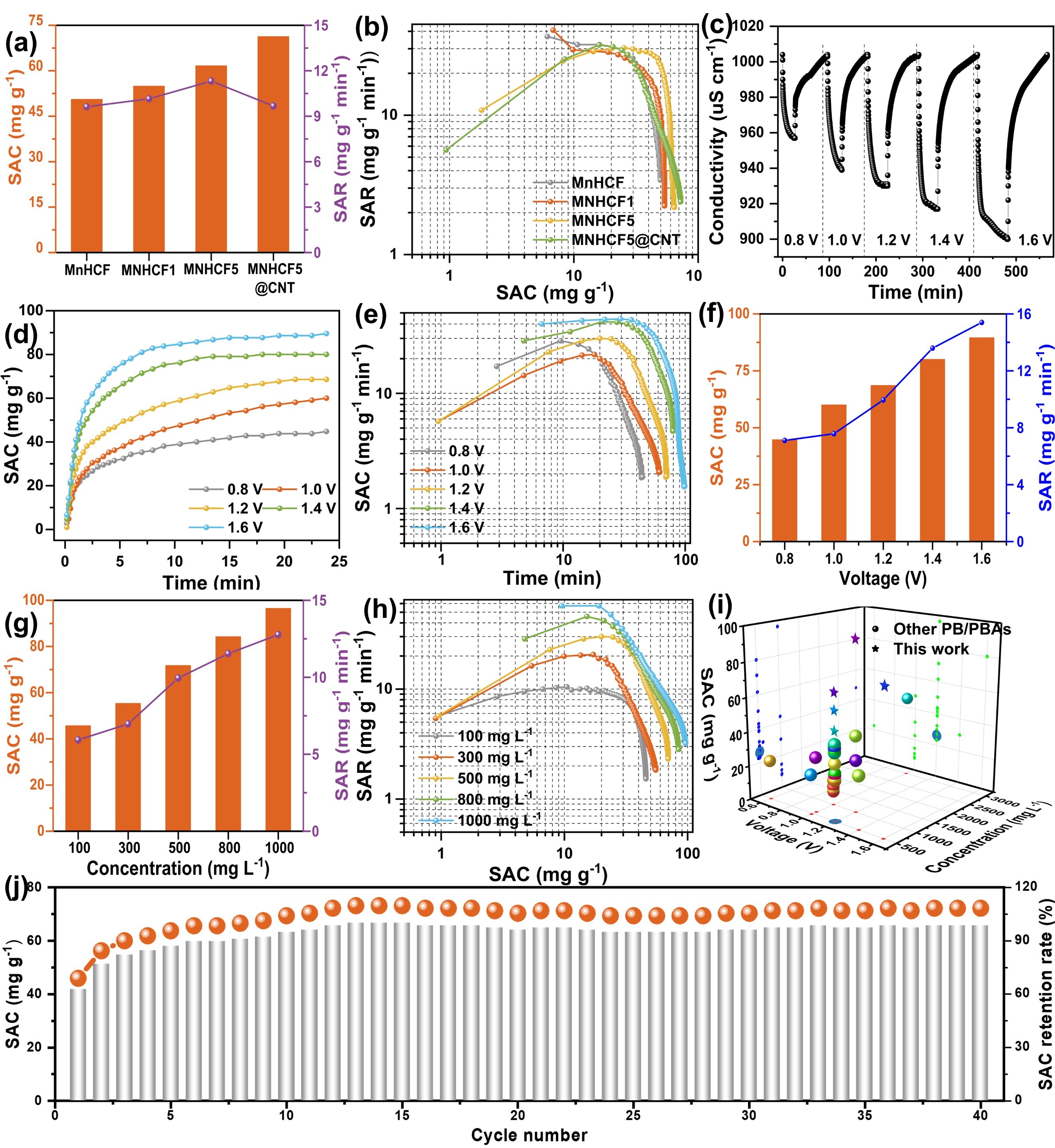
HCDI desalination performance of MNHCF@CNT. (Image by TANG Qi)
<関連情報>
- https://english.hf.cas.cn/nr/rn/202609/t20260921_1200953.html
- https://www.sciencedirect.com/science/article/abs/pii/S1005030225009387?via%3Dihub
NiドーピングとCNT複合化によるMnHCFの構造安定性と電気伝導性の向上による効率的なハイブリッド容量脱イオン化 Achieving enhanced structural stability and electrical conductivity of MnHCF through Ni doping and CNT composite for efficient hybrid capacitive deionization
Zhouyi Chen, Xiao Zhang, Qi Tang, Wusong Geng, Chengyun Gong, Yunxia Zhang, Guozhong Wang
Journal of Materials Science & Technology Available online: 19 September 2025
DOI:https://doi.org/10.1016/j.jmst.2025.08.049
Highlights
- MNHCF5@CNT cathode was fabricated for hybrid capacitive deionization.
- The electron transport channel is established through the composite of CNT.
- Nickel doping enhances the structural stability of MnHCF.
- MNHCF5@CNT exhibits excellent salt adsorption capacity and stability.
Abstract
The substitution of transition metals and construction of conductive skeleton to improve the stability and conductivity were studied for high-efficiency hybrid capacitive deionization (HCDI). Herein, the carbon nanotubes composite nickel-doped manganese hexacyanoferrate three-dimensional material (MNHCF@CNT) with multiple redox electron pairs and high-speed ion transport channels was successfully synthesized by a one-step co-precipitation method. The synthesized MNHCF@CNT material exhibited high specific capacitance, low charge transfer resistance and excellent electrochemical stability. What is more, it achieved a high salt adsorption capacity of 71.28 mg g−1, ultrahigh maximum salt adsorption rate of 31.89 mg g−1 min−1, and maintained 98.72 % of maximum salt adsorption capacity after 40 cycles. This exceptional HCDI performance primarily stems from the formation of robust Ni-N bonds via Ni substitution in MnHCF, improving the structural stability and ion diffusion kinetics. Meanwhile, efficient electron transport pathways are established through carbon nanotubes to suppress the volume expansion during the ion insertion/extraction process, thus improving the conductivity, ion storage capacity and cycle stability of the material. This work delivers actionable insights into the design of stable and highly efficient PBAs electrodes, critical for next-generation desalination technologies and hard water softening systems.