
2026-07-27 コロンビア大学
<関連情報>
- https://www.publichealth.columbia.edu/news/widespread-lithium-found-drinking-water-across-communities-western-u-s
- https://www.nature.com/articles/s41370-026-00947-7
米国西部地域におけるリチウム曝露:ストロングハート家族研究における水および尿中濃度 Lithium exposure in areas of the Western United States: Water and urinary levels in the Strong Heart Family Study
Ellen B. Bannon,Wil Lieberman-Cribbin,Anirban Basu,Arijeet Mitra,Chiugo Izuchukwu,James Ross,Shams Azad,Whitney Collado,Allison Kupsco,Arce Domingo Relloso,Jeff Goldsmith,Jason G. Umans,Ying Zhang,Tauqeer Ali,Amanda M. Fretts,Tracy Zacher,Rae O’Leary,Marcia O’Leary,Benjamin C. Bostick,Steven N. Chillrud,Ana Navas-Acien,Anne E. Nigra & Kathrin Schilling
Journal of Exposure Science & Environmental Epidemiology Published:23 July 2026
DOI:https://doi.org/10.1038/s41370-026-00947-7
Abstract
Background
Lithium production and processing is rapidly expanding, potentially increasing its environmental release. However, population-level exposure is poorly characterized in most countries.
Objective
Our objective was to evaluate drinking water and urinary lithium levels in the Strong Heart Family Study, a longitudinal study conducted with tribal partners in Arizona, Oklahoma, and North Dakota and South Dakota.
Methods
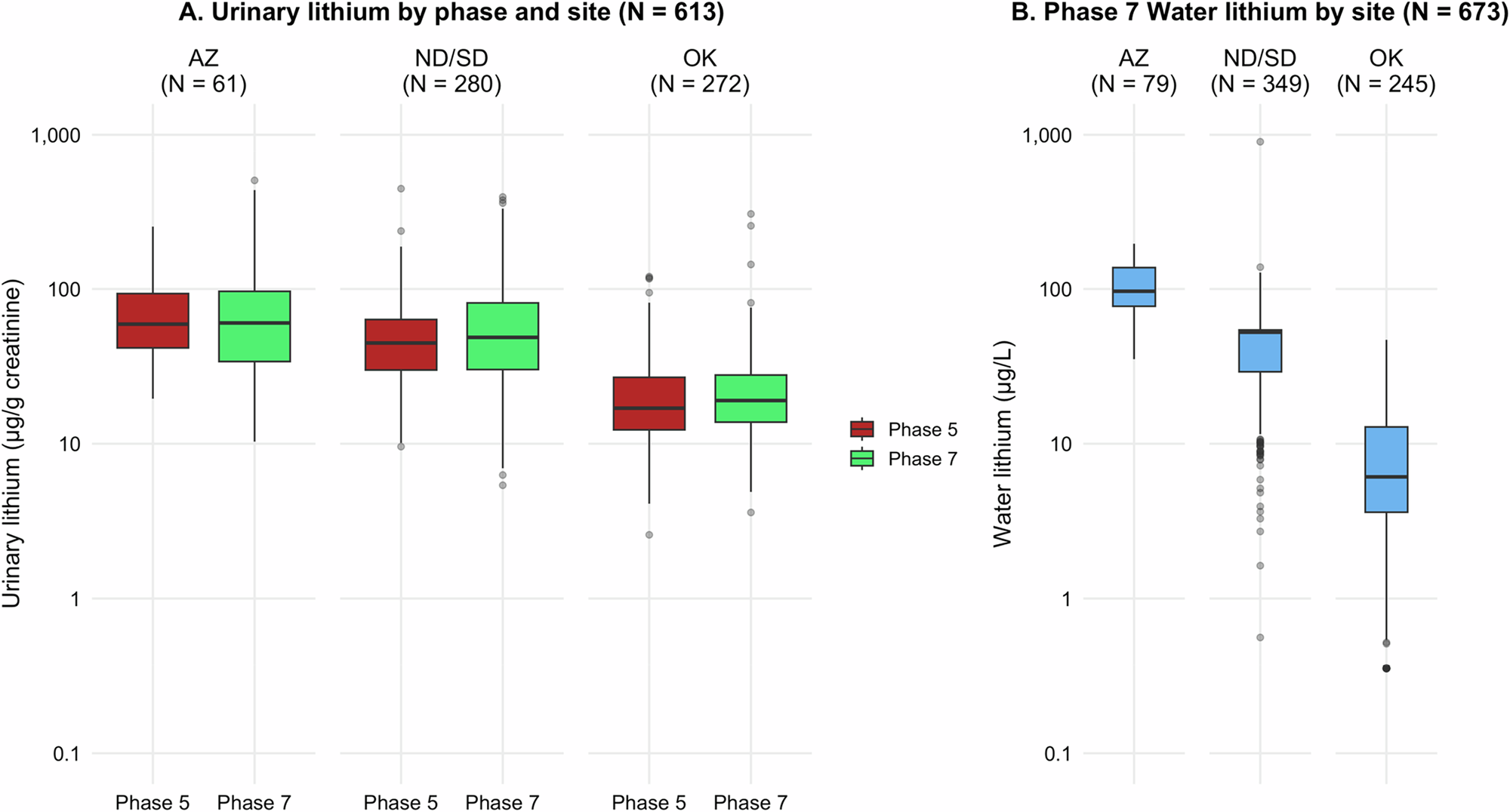
Lithium was measured in household tap water samples collected in 2022–2024 (n = 673) and spot urine samples collected in 2006–2009 and 2022–2024 (n = 613 paired samples). We examined within-person changes in urinary lithium, correlations between water and urinary lithium, and used mixed-effects models to estimate geometric mean ratios (GMRs) of urinary lithium in relation to study phase, water lithium, water source, and participant characteristics.
Results
Median (interquartile range) water lithium was 35.6 (9.0, 54.1) µg/L. Water lithium exceeded the United States Geological Survey health-based screening level (10 µg/L) in 100% of Arizona, 93% of North Dakota/South Dakota, and 35% of Oklahoma samples. Median urinary lithium was 30.8 (17.4, 53.3) µg/g creatinine in 2006–2009 and 31.2 (18.0, 56.0) in 2022-2024. The GMR comparing urinary lithium in 2022-2024 to 2006-2009 was 1.08 (1.02–1.14). Water lithium correlated with urinary lithium in 2006-2009 (ρ = 0.61) and 2022-2024 (ρ = 0.59). Each doubling of water lithium was associated with 22% higher urinary lithium before and 9% higher after adjustment for study site; all models adjusted for participant characteristics and water source. Water lithium explained 29% of variation in urinary lithium levels.
Significance
Lithium in drinking water is a widespread and persistent source of human exposure across Tribal communities in the Western United States, with regional variation. Our findings also support the use of urinary lithium as a biomarker of environmental exposure.
Impact
Our study provides novel evidence of high levels of lithium in household drinking water (2022–2024) in Native American communities. We found that drinking water lithium in Arizona, North Dakota and South Dakota often exceeded the United States Geological Survey health-based screening level, urinary lithium levels remained stable over 15-years of follow-up, and household drinking water lithium explained a substantial proportion of variability in urinary lithium. Our findings improve lithium exposure estimations among Strong Heart Family Study communities and support the need for further environmental monitoring and risk evaluation, particularly as lithium extraction and processing accelerate to meet energy demands.

