2026-09-16 中国科学院(CAS)
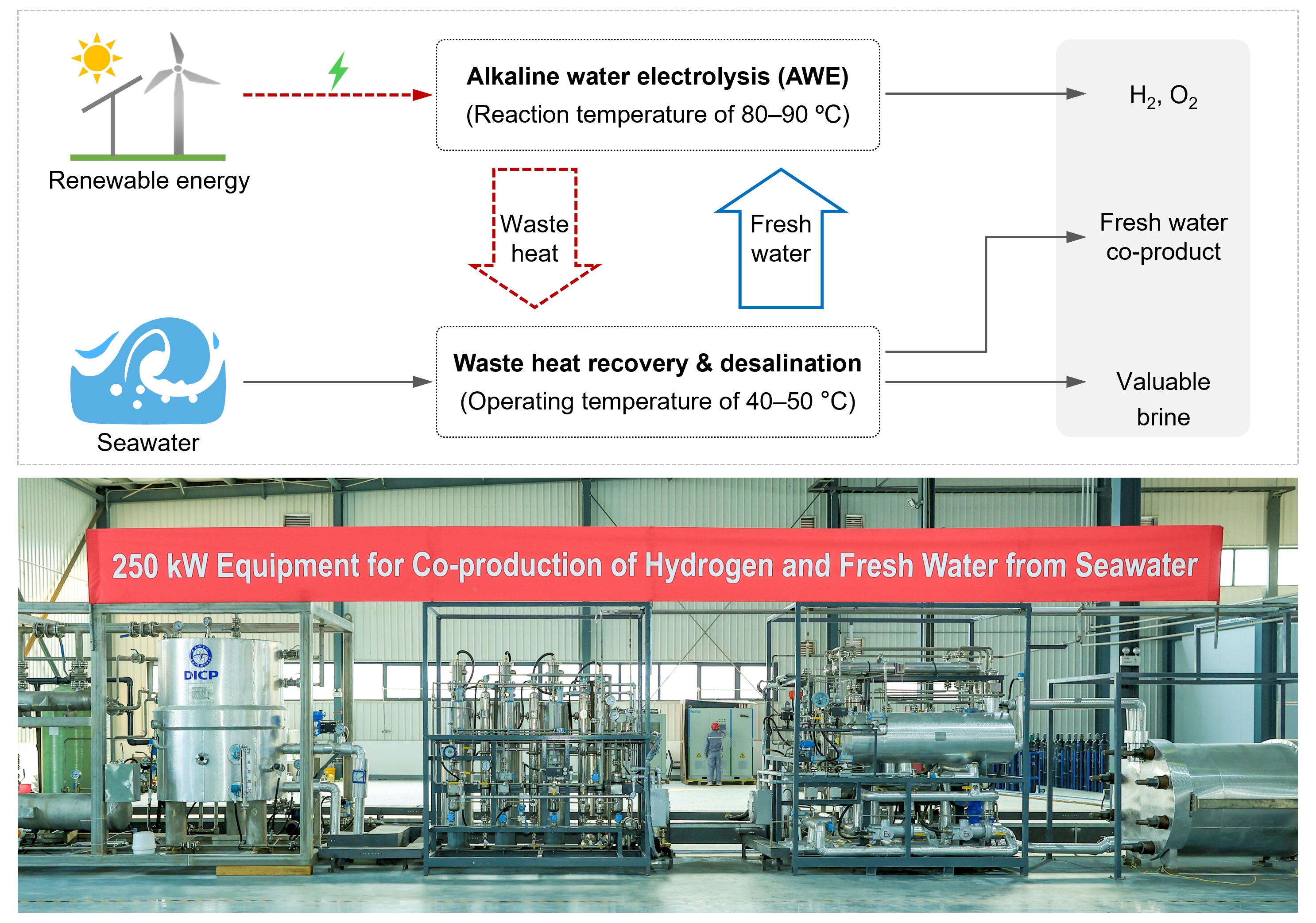
A 250 kW system and its process for co-production of hydrogen and fresh water from seawater. (Image by JIANG Shang)
<関連情報>
- https://english.cas.cn/newsroom/research-news/202609/t20260916_1200768.shtml
- https://www.nature.com/articles/s41560-026-02130-6
海水から水素と淡水を同時生産する250キロワットのシステム A 250-kilowatt system for co-production of hydrogen and fresh water from seawater
Shang Jiang (蒋赏),Peixin Zhu (朱培鑫),Yanting Liu (刘艳廷) & Dehui Deng (邓德会)
Nature Energy Published:15 September 2026
DOI:https://doi.org/10.1038/s41560-026-02130-6
Abstract
Hydrogen production from seawater is attractive given its abundance, but direct seawater electrolysis is challenging due to the poor stability and low energy efficiency. Here we report the co-production of hydrogen and fresh water from seawater by coupling alkaline water electrolysis with low-temperature desalination, wherein low-grade waste heat from the electrolyser drives seawater distillation to generate fresh water for both electrolysis and external use. A 20-kW industrial pilot system achieved co-productivities of 3.8 Nm3 h−1 H2 and 1.2 kg h−1 fresh water with stable operation for 100 days. Scaling up to 250 kW achieved 48 Nm3 h−1 H2 and 31.6 kg h−1 fresh water, with a 14.4% improvement in system electrical efficiency relative to alkaline electrolysis of fresh water alone. Techno-economic analysis of the coupled process indicates higher profitability than the traditional tandem process of desalination followed by electrolysis.