

2026-09-11 北海道大学
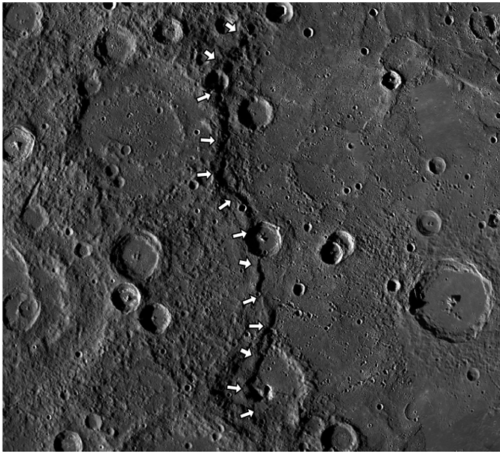
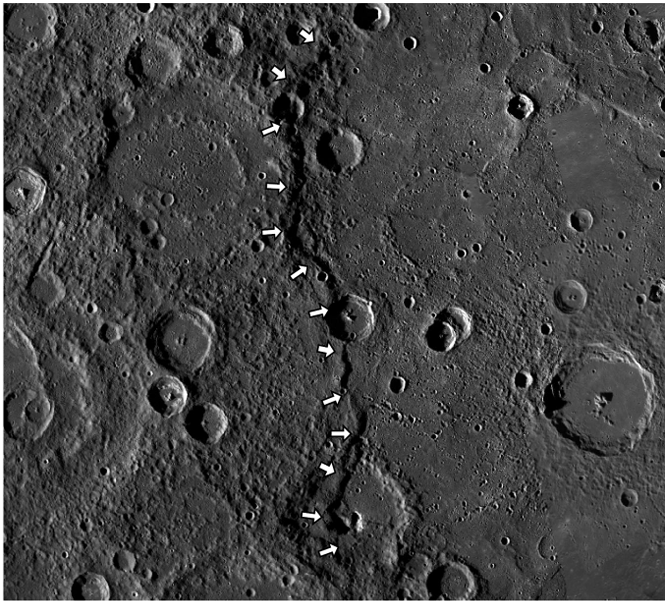
図1.水星の収縮地形の例。白い矢印で示されている箇所が収縮地形に対応する断崖。
<関連情報>
- https://www.hokudai.ac.jp/news/2026/09/10km.html
- https://www.hokudai.ac.jp/news/pdf/260911_pr.pdf
- https://agupubs.onlinelibrary.wiley.com/doi/10.1029/2026GL124067
表面ラフネスによる被覆がもたらす惑星収縮量の過小評価:水星の場合 Underestimation of Planetary Contraction Due To Obscuration by Surface Roughness: The Case of Mercury
G. Nishiyama, A. Broquet, N. Tosi, F. Preusker, A. Stark, H. Hussmann, E. Hauber
Geophysical Research Letters Published: 10 September 2026
DOI:https://doi.org/10.1029/2026GL124067
Abstract
Estimating Mercury’s radial contraction is key to understanding the planet’s geodynamic evolution. Contraction has been inferred from mapped shortening structures, whose heterogeneous distribution contradicts the isotropic contraction expected from global cooling. Here we investigate the possibility that the tectonic record is partly obscured by geologically recent resurfacing features like crater ejecta. Using topographic roughness as a proxy for surface freshness, we examine how roughness influences the mapped distribution of shortening structures. Our new global roughness map is compared to contractional strain maps derived from a shortening structures catalog. We find a lack of shortening structures in rough regions, suggesting that roughness-related processes obscure pre-existing structures, hindering their identification, and/or inhibiting their formation. This obscuration effect biases previous contraction estimates downward by several kilometers, implying that Mercury’s radial contraction is up to 30% larger than previously thought. This roughness bias may also be critical for other terrestrial bodies like the Moon.

