2026-09-10 中国科学院(CAS)
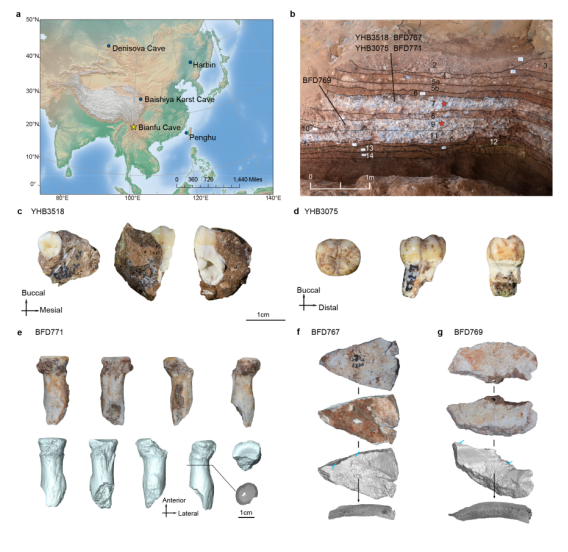
The geographical location of the Bianfu Cave and the morphology of the two human teeth and three newly discovered Denisovan bones. (Image by IVPP)
<関連情報>
- https://english.cas.cn/newsroom/research-news/202609/t20260906_1192641.shtml
- https://www.nature.com/articles/s41586-026-10976-9
古代タンパク質が中国南西部の様々なデニソワ人の遺骸を特定 Ancient proteins identify various Denisovan remains from Southwest China
Huiyun Rao,Song Xing,Qijun Ruan,Fan Bai,Yuhao Zhao,Zhongyou Wu,Siyuan Tang,E. Andrew Bennett,Xiaotian Feng,Sungui Lin,Qingfeng Shao,Xiong Yang,Zitao Li,Kai Zhou,Feng Liu & Qiaomei Fu
Nature Published:09 September 2026
DOI:https://doi.org/10.1038/s41586-026-10976-9
Abstract
More than a decade of multidisciplinary research has identified a collection of cranial, facial and dental remains of Denisovans from across Asia, providing insight into their cranial capacity, appearance, diet and evolutionary history. However, our understanding of their spatiotemporal dispersal and morphological phenotype is limited by a conspicuous distribution gap in Southwest China and the scarcity of postcranial remains, in particular, the absence of long bones with diagnostic characteristics. To identify further hominin long bones, we morphologically screened more than 60,000 bone fragments from Bianfu Cave in Southwest China, of which 76 were selected for zooarchaeology by mass spectrometry and 17 for proteomic sequencing analysis. These analyses identified three hominin fossils, comprising two parietal bone fragments and one proximal radial fragment, from layers dated to approximately 167–134 thousand years ago1. Subsequent proteomic analysis confirmed the taxonomic affiliation of these newly identified hominin bones, as well as that of two hominin teeth discovered during the excavation, as Denisovan. These findings establish Bianfu Cave as a Denisovan locality yielding the most abundant remains of this hominin group outside Denisova Cave in Siberia. The results also fill a critical geographic gap in the documented distribution of Denisovans and refine our understanding of their evolutionary history. Furthermore, this study provides direct information on the radial morphology of Denisovans, providing insight into their postcranial phenotype.