2026-09-08 ワシントン大学セントルイス校
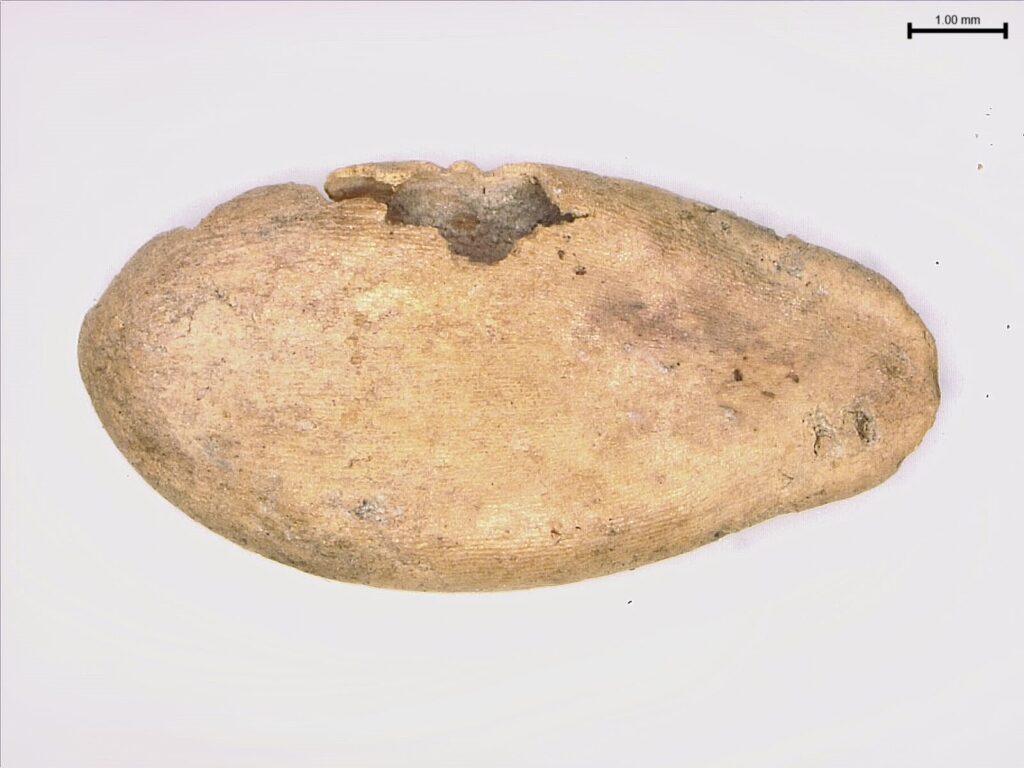
A waterlogged melon seed remain uncovered from Shuomen Gugang (Photo: Xinyi Liu and Melissa Ritchey)
<関連情報>
- https://source.washu.edu/2026/09/waterlogged-seeds-reveal-melons-ancient-journey/
- https://www.pnas.org/doi/10.1073/pnas.2610284123
古代DNA分析により、中国宋代におけるメロンの早期利用が明らかになった Ancient DNA reveals early use of melons in China’s Song dynasty
Nathanael Walker-Hale, Yunfei Zheng, Marion Verdenaud, +9 , and Susanne S. Renner
Proceedings of the National Academy Chemistry Published: September 4, 2026
DOI:https://doi.org/10.1073/pnas.2610284123
Abstract
Melon (Cucumis melo L.) domestication is thought to have occurred independently once in Northeast Africa and twice in India, but archaeobotanical seed remains point to a possible additional domestication event in China. Because Cucumis seeds are difficult to diagnose morphologically, genomic data from archaeological material are needed to evaluate these scenarios and reconstruct ancient melon traits. We sequenced two Song Dynasty (960–1279 CE) melon seeds from Shuomen Gugang (China), recovering 5.5× and 2.1× nuclear genome coverage. Nuclear and chloroplast analyses place both seeds within cultivated C. melo from China, within the “agrestis” East Asian gene pool. To assess whether these seeds carried traits associated with sweet dessert melons, we examined loci underlying fruit phenotypes. Neither seed carried alleles for orange flesh; one harbored an allele linked to yellow/orange peel, the other possessed alleles associated with green flesh and reduced acidity. Since wild melons are monoecious, the presence of the derived andromonoecy allele in one seed, associated with rounder fruit shape, suggests early selection on fruit morphology. Together, these findings indicate that Song Dynasty melons were likely consumed as fresh or culinary fruits rather than sweet dessert melons. Their flesh coloration resonates with Song-period aesthetic sensibilities, exemplified by jade-green celadon ceramics frequently crafted in melon-shaped forms. By anchoring East Asian archaeobotanical remains within modern melon genomic variation, this study provides a temporal framework for melon cultivation in China and shows how ancient genomics can illuminate past crop use.