2026-09-07 合肥物質科学研究院(HFIPS)
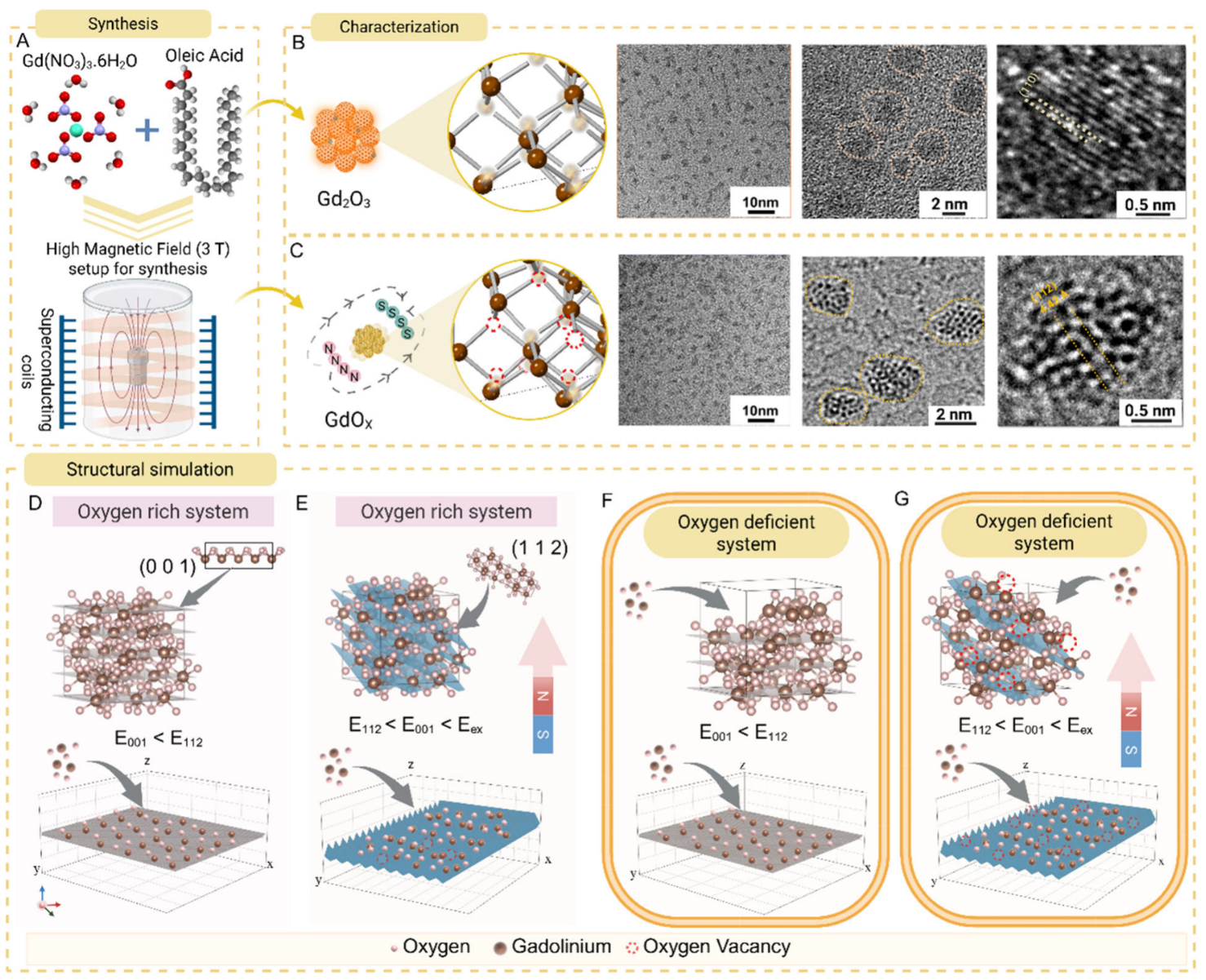
Magnetic field-mediated growth changes the preferred orientation of GdOx nanoparticles from (001) to (112) (Image by MA Kun)
<関連情報>
- https://english.hf.cas.cn/nr/bth/202609/t20260907_1192714.html
- https://pubs.acs.org/nalefd/article-abstract/26/34/11378/5274717/Magnetically-Induced-Oxygen-Vacancies-and-Spin
T1強調MRI を強化するための GdO xナノプローブにおける磁気誘導酸素空孔とスピン傾斜 Magnetically Induced Oxygen Vacancies and Spin Canting in GdOx Nanoprobes for Enhanced T1–Weighted MRI
Sajid ur Rehman;Zehua Li;Xianglong Zhao;Muhammad Asif;Rida Ahmed;Hossein Kazemian;Zhen Wang;Yunyu Cai;Xinliang Huang;Changhao Liang;Hong Bi;Qingyou Lu;Xin Zhang;Juan Wan;Ning Hao;Jing Tao;Guangli Kuang;Kun Ma;Junfeng Wang
Nano Letters Published:August 18, 2026
DOI:https://doi.org/10.1021/acs.nanolett.6c02465
Abstract
Engineering oxygen vacancies at the nanoscale is instrumental for controlling oxygen dynamics that underpin diverse functional behaviors in oxide materials. Here, we present a magnetic-field-assisted synthesis platform that leverages static magnetic fields (3 T) to actively engineer oxygen vacancies in gadolinium oxide (GdOx) nanoparticles. By exploiting Lorentz forces and Zeeman interactions during crystallization, this method induces facet reorientation and disrupts oxygen incorporation, yielding a 3.5-fold increase in surface oxygen vacancies compared with thermal synthesis. These vacancies act as spin-canting centers, amplifying paramagnetic interactions and enhancing magnetic relaxivity. The defect-engineered GdOx nanoprobes provide stronger and more persistent contrast enhancement in tumor-bearing mice than control nanoparticles and clinical Gd-DTPA with negligible gadolinium leakage and complete renal clearance. Beyond biomedical applications, this work establishes magnetic-field-assisted synthesis as a generalizable platform for defect engineering in nanomaterials, offering precise control over spin structures and defect–property relationships.