2026-09-03 京都大学
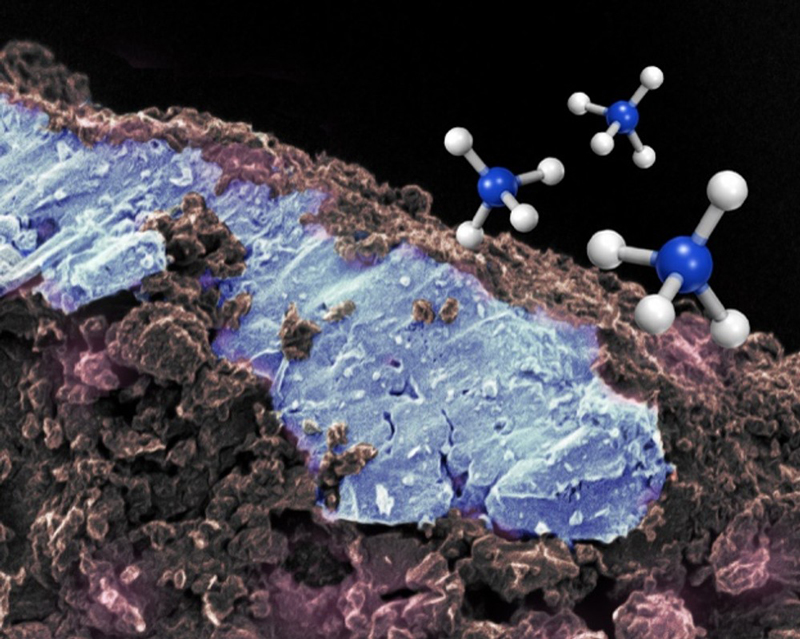
リュウグウの砂の塩鉱物(青色)と粘土鉱物(茶色)の電子顕微鏡擬似カラー画像とアンモニウム分子(NH₄⁺)のイラスト。(京都大学)
<関連情報>
- https://www.kyoto-u.ac.jp/ja/research-news/2026-09-03-1
- https://www.nature.com/articles/s41550-026-02962-y
リュウグウ⺟天体の末期塩⽔に関連するアンモニウム含有粘土と多様な窒素化学種 Ammonium-bearing clays and multiple nitrogen species linked to the late-stage brines of Ryugu’s parent body
Toru Matsumoto,Hayato Yuzawa,Mizuho Koike,Yoko Kebukawa,Takaaki Noguchi,Toru Yada,Hiroki Suga,Toshiaki Ina,Hiroshi Sakuma,Yohei Shirose,Yuki Kitamura,Yohei Igami & Akira Miyake
Nature Astronomy Published:27 August 2026
DOI:https://doi.org/10.1038/s41550-026-02962-y
Abstract
Nitrogen-bearing compounds are key precursors for prebiotic organic synthesis in the early Solar System. Spectroscopic detections of ammoniated salts and clays on the dwarf planet Ceres and several carbonaceous asteroids suggest a widespread distribution of ammonia reservoirs across the Solar System and their association with water activity. However, its storage in meteorites remains poorly constrained. Regolith samples recovered from asteroid Ryugu preserve evidence of past water–rock interactions in its carbonaceous parent body. Here, using infrared spectroscopy, X-ray spectroscopy and electron microscopy, we study Ryugu samples and report the presence of ammonium-bearing phyllosilicates, C≡N-bearing species and sodium nitrate, all spatially associated with sodium carbonate. The concentration of nitrogen species and the incorporation of ammonium into phyllosilicates probably occurred during the disappearance of the late-stage brines, when sodium carbonate precipitated. We suggest that reactive ammonia and C≡N-bearing species were accreted during parent-body formation and persisted until aqueous activity ceased, serving as sustained nitrogen sources for prebiotic organic synthesis. The nitrogen enrichment in the residual brines could have enhanced intermolecular organic reactions and possibly promoted dehydration-driven polymerization. By analogy with Ryugu, subsurface brines concentrated during cryovolcanic activity on ammonium- and salt-rich icy bodies such as Ceres may have provided favourable environments for nitrogen-related organic reactions.