2026-09-01 産業技術総合研究所
<関連情報>
- https://www.aist.go.jp/aist_j/press_release/pr2026/pr20260901/pr20260901.html
- https://pubs.acs.org/jacsat/article-abstract/148/33/35278/5253677/Chemically-Modified-Sugars-as-Multifunctional
化学修飾糖を多機能前駆体として用いたナノ多孔質炭素材料の直接的かつテンプレートフリー合成 Chemically Modified Sugars as Multifunctional Precursors for Direct, Template-Free Synthesis of Nanoporous Carbonaceous Materials
Shiori Kubo;Joshua Philip Barham;Norihito Hiyoshi
Journal of the American Chemical Society Published:August 12, 2026
DOI:https://doi.org/10.1021/jacs.5c16771
Abstract
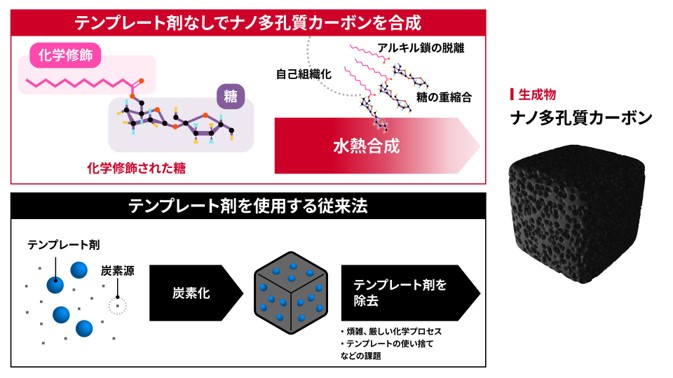
Carbonaceous solids with pores in the nanometer domain are of great technological importance owing to their amenability to sorption/separation, catalysis, and electrochemical applications. Herein, we demonstrate that a simple yet targeted chemical modification of sugar, specifically the use of alkylated sucrose as a carbon precursor, leads to direct nanostructuring of carbonaceous solids and template-free production of porous carbonaceous solids via in situ pore formation (i.e., self-generation of pores) under a hydrothermal environment. Chemically modified sugars are multifunctional and programmable, allowing tuning of (i) self-assembly (due to amphiphilicity), (ii) carbonization (via condensation of the sugar backbone), and (iii) tail cleavage (via linker decomposition). The synthetic approach was further extended to the synthesis using another alkylated sugar precursor with a different sugar headgroup. Wet-laboratory synthesized fructose monolaurate yielded a layered carbonaceous nanostructure upon hydrothermal carbonization. Finally, the porous carbonaceous solid synthesized hydrothermally utilizing alkylated sucrose at a higher aqueous concentration exhibited a high specific surface area of 1155 m2 g–1 and a total pore volume of 1.00 cm3 g–1 with uniform, ∼32 nm-sized pores. Our demonstrated procedure presents advantages over the widely exploited, conventional templating method. It does not require sacrificial templates; hence, access to novel porous structures is not restricted by the availability and effectiveness of templates. Our precursor modification-based, direct one-step procedure is an attractive tool for precise yet flexible pore control and as a future resource- and energy-efficient approach toward nanoporous carbonaceous solids.