2026-08-27 高知工科大学
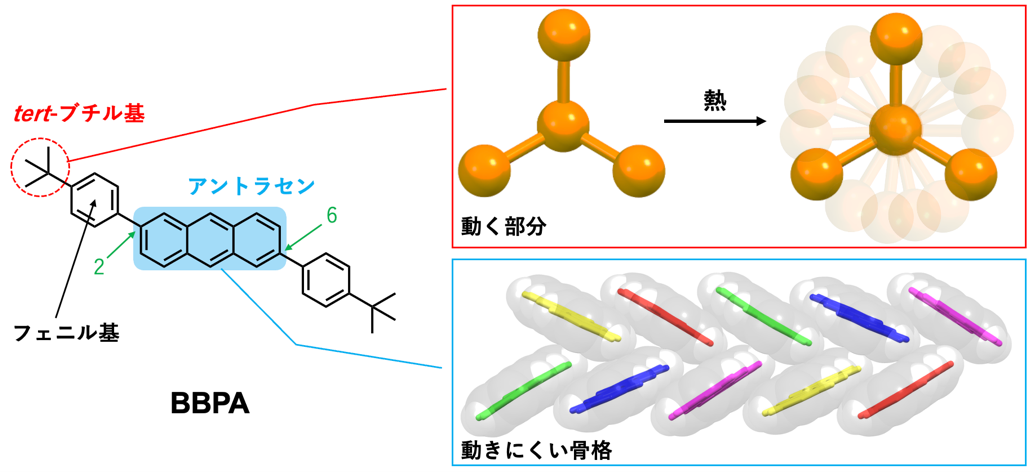
▲「動く部分」と「動きにくい(剛直な)骨格」を組み合わせた新分子(BBPA)の設計
<関連情報>
- https://www.kochi-tech.ac.jp/news/2026/007093.html
- https://onlinelibrary.wiley.com/doi/10.1002/smll.75273
単純さから複雑さへ:熱的に堅牢でありながらプログラム可能な異方性膨張のための設計原理としての置換基制御Z ‘多重度 From Simplicity to Complexity: Substituent-Controlled Z′ Multiplicity as a Design Principle for Thermally Robust Yet Programmable Anisotropic Expansion
Yuto Hino, Takumi Matsuo, Tomohiro Yamashita, Hiroko Yokota, Daiki Korenaga, Tomohiro Seki, Shotaro Hayashi
Small Published: 18 August 2026
DOI:https://doi.org/10.1002/smll.75273
ABSTRACT
Anisotropic thermal expansion in molecular crystals has predominantly been reported for low-Z′ systems (Z′ ≤ 2), in which only a few independent molecules occupy the asymmetric unit. In such crystals, thermal expansion is often interpreted using simplified models based on rigid molecular motion or averaged intermolecular interactions. However, these descriptions fail to capture the complex anisotropy, switchable responses, and multistep phase transitions frequently observed in molecular solids. Here, we report high-Z′ molecular crystals that exhibit both thermal robustness and stepwise, rapid anisotropic thermal expansion upon temperature variation. These crystals were designed by combining substituent-induced molecular asymmetry, competitive intermolecular interactions, and flexible intramolecular degrees of freedom. Crystals of 2,6-bis(4-tert-butylphenyl)anthracene display an unusually high Z′ value of 5 over a wide temperature range (100–400 K), enabled by the noncovalent immobilization of coplanar tert-butyl groups within a herringbone packing framework. Upon heating, progressive molecular motions induce dynamic averaging of crystallographically distinct local environments, culminating in a cooperative phase transition accompanied by symmetry recovery and reduction of Z‘ from 5 to 2.5 at 423 K. The resulting structural reorganization gives rise to rapid macroscopic anisotropic thermal expansion. These results establish high-Z′ crystal engineering as a viable strategy for programmable and reversible thermal-mechanical responses.