
2026-08-27 マサチューセッツ工科大学(MIT)
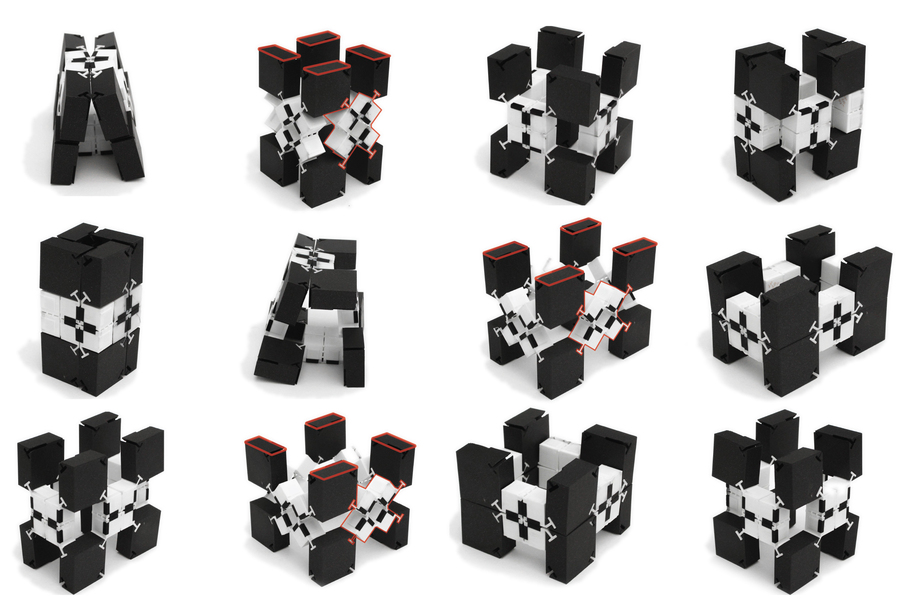
These rows show just a portion of the wide variety of configurations the Bifur-circuits can make. Credit: Courtesy of the researchers
<関連情報>
- https://news.mit.edu/2026/mit-engineers-create-system-for-building-shape-changing-smart-devices-0827
- https://hcie.csail.mit.edu/research/Bifur-circuit/bifur-circuits.html
- https://tiisys.com/blog/2025/08/19/post-173672/
分岐回路:分岐形状によるインタラクティブでモジュール式のメタマテリアル構成要素
Bifur-circuits: Interactive and Modular Metamaterial Building Blocks Via Bifurcated Geometries
Marwa AlAlawi, Regina Zheng, Abdullah Negm, Jiaji Li, Emma Li, Yasuaki Kakehi, Yoshihiro Kawahara, Junyi Zhu, Ticha Sethapakdi, Stefanie Mueller
Mechanical metamaterials have gained traction in the HCI community for enabling interactive applications, including shape-changing displays and novel sensing paradigms. However, these structures typically support a limited set of stable geometric configurations, constraining the range of geometric expressions they can support through modularity. To overcome this constraint, we present Bifur-circuits, a mechanically and electrically modular, fully 3D metamaterial assembly toolkit. Bifur-circuits enables interactive geometries capable of exhibiting an exponentially increasing number of configurations as a function of units in an assembly. It accomplishes this through two layers of mechanical reconfiguration: at the assembly level, where modules can be added or removed, and at the configuration level via mechanical bifurcation, where structures split into new stable configurations upon reaching a critical geometric threshold. All units are internally routed such that electrical modularity produces a valid and unique circuit per configuration.
We contribute a Fusion 360-based construction tool, a Java-C++ simulation tool for real-time shape recognition, and a multi-material 3D printing fabrication pipeline. Our technical evaluation shows that Bifur-circuits maintain electrical connectivity after 10k cyclic compressions, and that shape recognition latency scales linearly with unit count (20 units maps to a 5-second detection time). Finally, we contribute two applications demonstrating Bifur-circuits’ potential, across scales, for reconfigurable spatial environments and adaptive tangible user interfaces.

