2026-08-19 北海道大学
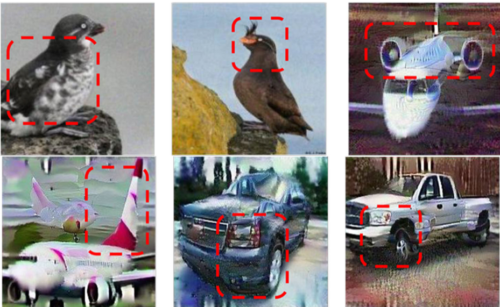
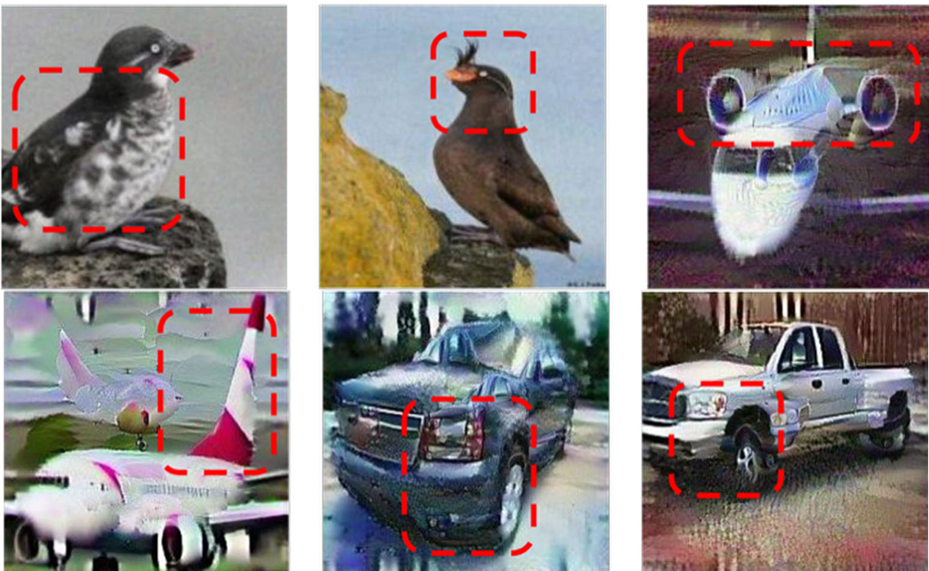
図1. 提案⼿法(FD²)が⽣成した合成画像及びその注⽬領域(⾚枠)
<関連情報>
- https://www.hokudai.ac.jp/news/2026/08/aiaifd.html?utm_source=chatgpt.com
- https://www.hokudai.ac.jp/news/pdf/260819_pr5.pdf
- https://arxiv.org/abs/2603.25144
FD²:細粒度データセット蒸留のための専用フレームワーク FD2: A Dedicated Framework for Fine-Grained Dataset Distillation
Hongxu Ma, Guang Li, Shijie Wang, Dongzhan Zhou, Baoli Sun, Takahiro Ogawa, Miki Haseyama, Zhihui Wang
arXiv last revised 27 Jun 2026 (this version, v2)
DOI:https://doi.org/10.48550/arXiv.2603.25144
Abstract
Dataset distillation (DD) compresses a large training set into a small synthetic set, reducing storage and training cost, and has shown strong results on general benchmarks. Decoupled DD further improves efficiency by splitting the pipeline into pretraining, sample distillation, and soft-label generation. However, existing decoupled methods largely rely on coarse class-label supervision and optimize samples within each class in a nearly identical manner. On fine-grained datasets, this often yields distilled samples that (i) retain large intra-class variation with subtle inter-class differences and (ii) become overly similar within the same class, limiting localized discriminative cues and hurting recognition. To solve the above-mentioned problems, we propose FD2, a dedicated framework for Fine-grained Dataset Distillation. FD2 localizes discriminative regions and constructs fine-grained representations for distillation. During pretraining, counterfactual attention learning aggregates discriminative representations to update class prototypes. During distillation, a fine-grained characteristic constraint aligns each sample with its class prototype while repelling others, and a similarity constraint diversifies attention across same-class samples. Experiments on multiple fine-grained and general datasets show that FD2 integrates seamlessly with decoupled DD and improves performance in most settings, indicating strong transferability. Code is available at this https URL.