2026-08-19 合肥物質科学研究院(HFIPS)
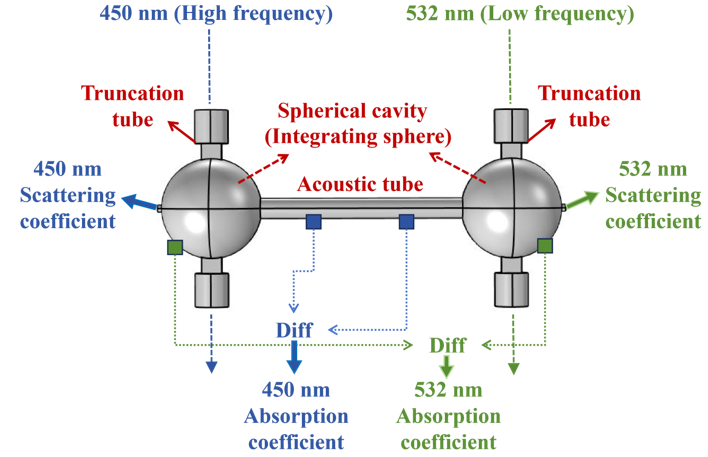
Core structure of the dual-differential sphere–tube coupled photoacoustic–scattering system (Image by LI Zhengang)
<関連情報>
- https://english.hf.cas.cn/nr/rn/202608/t20260819_1188077.html
- https://www.sciencedirect.com/science/article/pii/S2213597926000704
二重差動球管結合光音響散乱システムを用いたエアロゾル光学特性の時空間同期二波長測定 Spatiotemporally synchronized dual-wavelength measurement of aerosol optical properties using a dual-differential sphere–tube coupled photoacoustic–scattering system
Zhengang Li, Hepeng Zhang, Daming Dong, Yonghua Fang
Photoacoustics Available online: 29 July 2026
DOI:https://doi.org/10.1016/j.pacs.2026.100864
Abstract
To reduce potential inconsistencies in particle transport, temporal response, and microenvironment in conventional split-type aerosol absorption–scattering systems, we developed a dual-wavelength spatiotemporally synchronized measurement method. Two integrating spheres serve as scattered-light collection cavities and acoustic buffers and form a low-frequency differential Helmholtz resonator, while the central tube supports a high-frequency differential second-order longitudinal mode. The 450 and 532 nm lasers were modulated at 2572 and 169 Hz and synchronously demodulated using an FPGA-based digital lock-in amplifier. Absorption channels were calibrated with NO₂, and scattering channels with N₂/CO₂ Rayleigh scattering. At 1 s integration and a 3σ criterion, the 532 nm absorption and scattering limits of detection were 1.2 and 1.32 Mm⁻¹ . Water-mist, controlled-combustion, and field tests evaluated channel isolation, relative spectral response, and ambient-operation feasibility. The system simultaneously measures dual-wavelength absorption and scattering within a common volume through a single sampling path.