2026-08-12 北京大学(PKU)
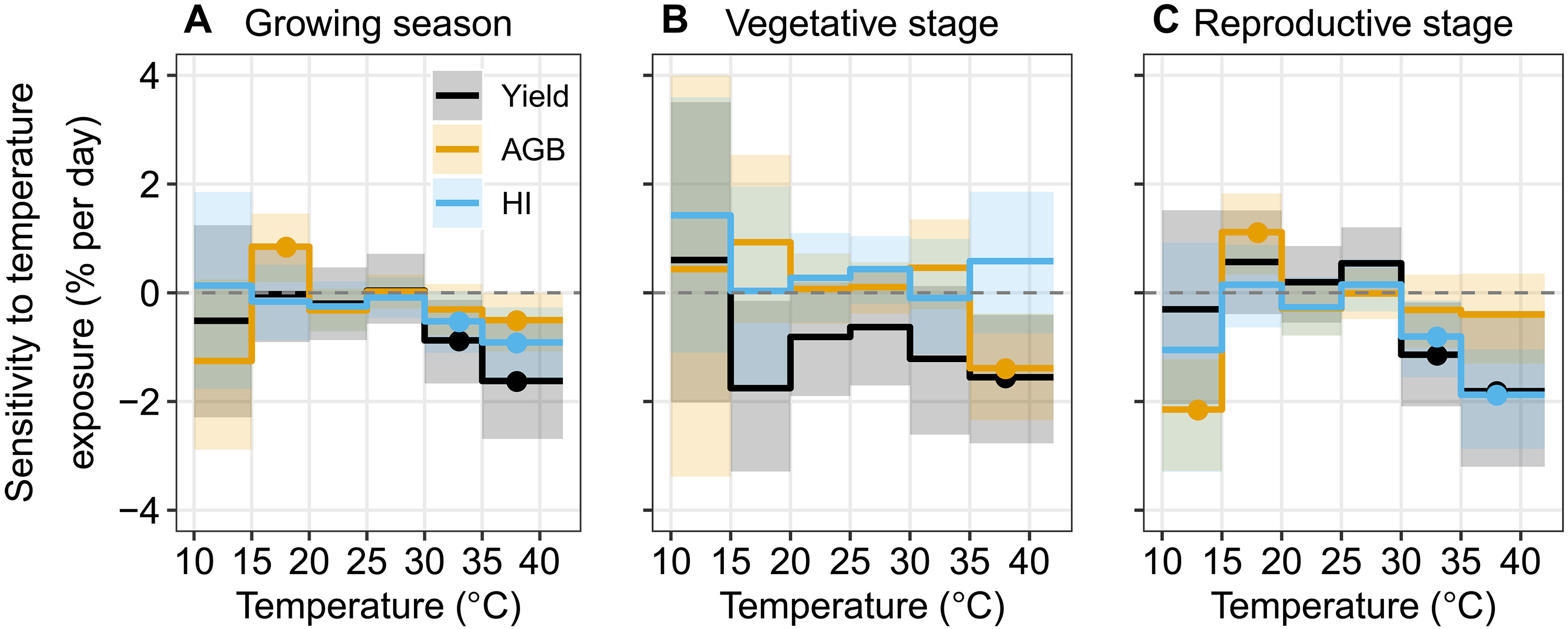
Fig. Sensitivities of rice yield, AGB, and HI to high-temperature exposures.
<関連情報>
- https://newsen.pku.edu.cn/news_events/news/research/15634.html
- https://www.science.org/doi/10.1126/sciadv.aed9226
高温に対する脆弱性が、地球温暖化が米の収量に及ぼす影響を左右する Vulnerability to high temperature shapes global warming impacts on rice yield
Yiwei Jian, Xuhui Wang, Jonas Jägermeyr, Philippe Ciais, […] , and Feng Zhou
Science Advances Published:29 Jul 2026
DOI:https://doi.org/10.1126/sciadv.aed9226
Abstract
Complex and spatially varying warming impacts on rice yield hinder climate change impact assessments on food security. To address this issue, we compiled a global dataset of field-warming experiments (n = 214) and analyzed stage-specific crop responses to temperature variations. Results show that exposures to high (30° to 35°C) and extreme high (>35°C) temperatures are the dominant drivers of warming-induced rice yield losses, primarily through harvest index reductions. One additional exposure day above 30°C during the reproductive stage reduces rice yields by 1.1 to 1.8%. In contrast, current global gridded crop models underestimate this sensitivity, simulating only 0.1 to 1.3% yield loss per exposure day. After adjusting the model biases, we estimate that global rice yield losses decrease by 8.1% under 1°C of global warming, approximately twice the unadjusted estimates, with South and Southeast Asia being the most vulnerable regions. Our results highlight the critical role of high-temperature exposure in shaping warming impacts on rice yield.