2026-08-12 コンコルディア大学
<関連情報>
- https://www.concordia.ca/news/stories/2026/08/12/concordia-research-could-help-improve-aircraft-engine-durability.html
- https://www.nature.com/articles/s43246-026-01212-y
過酷な環境向けに開発された、釉薬を用いた自己修復セラミックコーティング Glaze-enabled self-healing ceramic coatings for extreme environments
Andre R. Mayer,Omar Zouina,Michael Chandross,Martin Dienwiebel,Christian Moreau & Pantcho P. Stoyanov
Communications Materials Published:15 June 2026
DOI:https://doi.org/10.1038/s43246-026-01212-y Unedited version
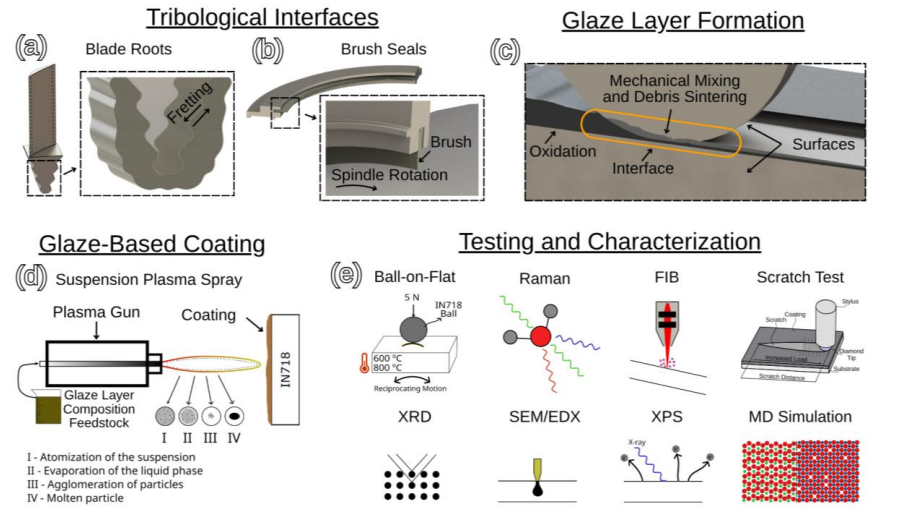
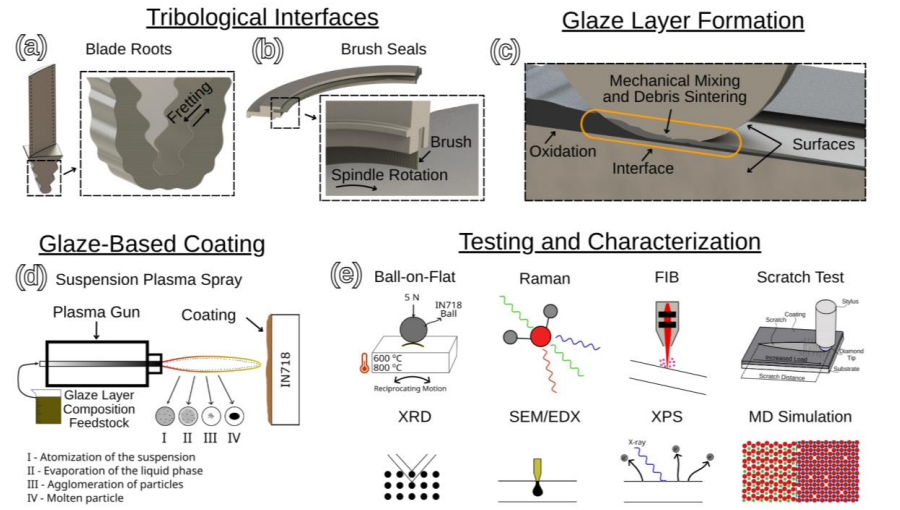
Fig.1
Abstract
Gas turbine engines operate under extreme thermal and mechanical stresses, where material degradation through crack formation and surface wear remains a critical challenge. Here, we report a self-healing coating system based on phase segregation in the CoO–Cr₂O₃ system that autonomously repairs thermally induced cracks at elevated temperatures. Mimicking the naturally formed glaze layers found in cobalt-based superalloys, these coatings not only enhance lubricity through the in-situ formation of cobalt oxides but also exhibit intrinsic damage tolerance. Crack healing occurs via defect-driven diffusion and segregation of cobalt oxide phases, which fill and seal microcracks, thereby preventing spallation and preserving surface integrity. The segregation is then constrained by the formation of Co3O4 when exposed to atmosphere, avoiding fully segregation and leaving a metastable core. This work demonstrates a pathway toward high-temperature coatings capable of self-repair, offering a strategy to improve the durability, reliability, and operational efficiency of next-generation gas turbine engines.