

2026-08-06 大阪大学
<関連情報>
- https://www.ist.osaka-u.ac.jp/japanese/news/newsDetailNews.php?id=618
- https://www.ist.osaka-u.ac.jp/uData/attachFile/info/00/00/05/45/【大阪大】PR(「光が得意な問題」を解く新たな計算モデルを提案)ーWeb.pdf
- https://www.nature.com/articles/s42005-026-02747-9
密な相互作用を伴う大規模二次無制約二値最適化の畳み込み定式化 Convolutional formulation of large-scale quadratic unconstrained binary optimization with dense interactions
Hiroshi Yamashita & Hideyuki Suzuki
Communications Physics Published:29 July 2026
DOI:https://doi.org/10.1038/s42005-026-02747-9
Abstract
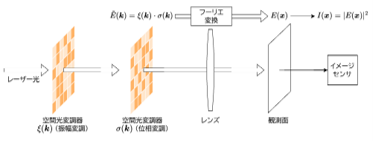
The spatial photonic Ising machine (SPIM) is a promising optical hardware solver for large-scale combinatorial optimization problems with dense interactions. As the SPIM can represent Ising problems with rank-one coupling matrices, multiplexed versions have been proposed to enhance applicability to higher-rank interactions. However, the multiplexing cost reduces implementation efficiency, and even without multiplexing, the SPIM can represent coupling matrices beyond rank-one. To clarify the intrinsic representation power of the SPIM, we propose spatial quadratic unconstrained binary optimization (spQUBO), a formulation of Ising problems with spatially convolutional structures. We prove that any spQUBO reduces to a two-dimensional spQUBO with the convolutional structure preserved, which can be efficiently implemented on the SPIM without multiplexing. We demonstrate its applicability to distance-based combinatorial optimization, including placement problems and clustering problems. These results advance our understanding of the class of optimization problems where SPIMs exhibit unique advantage in efficiency and scalability. Furthermore, the convolutional structure of spQUBO also enables efficient computation using Fast Fourier Transforms.

