2026-08-05 マックス・プランク研究所
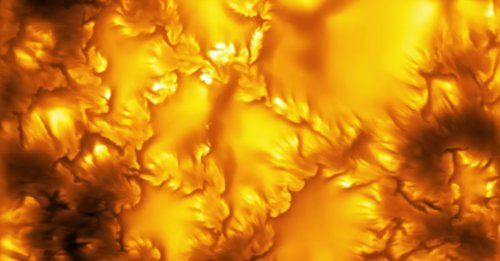
The highest-resolution image of the Sun’s surface (photosphere) ever captured, taken at 416 nanometers by the Inouye Solar Telescope. At the edges of the solar granules, the image reveals fringed-looking structures that display swirling motions. © NSF/NSO/AURA/MPS
<関連情報>
- https://www.mpg.de/26900660/tiny-vortices-discovered-on-the-sun-s-surface
- https://www.nature.com/articles/s41586-026-10871-3
太陽におけるプラズマ混合を促進する普遍的なケルビン・ヘルムホルツ不安定性 Ubiquitous Kelvin–Helmholtz instabilities driving plasma mixing on the Sun
David Kuridze,Friedrich Wöger,Michiel van Noort,Matthias Rempel,Robert Cameron,Thomas Rimmele,Sami K. Solanki,Sarah A. Jaeggli,Alexandra Tritschler,Han Uitenbroek,Damien Przybylski & David A. Boboltz
Nature Published:05 August 2026
DOI:https://doi.org/10.1038/s41586-026-10871-3
Abstract
The interaction between the magnetic field and turbulent convection in the Sun’s photosphere drives the dynamics, evolution and structuring of its magnetized atmosphere. This interaction often takes place at or below the spatial resolution of modern-day observations. Here we report on high-spatial-resolution observations of the solar photosphere acquired using the world’s first 4-m class solar telescope, the US National Science Foundation’s Daniel K. Inouye Solar Telescope. Time sequence images reveal a far more complex and dynamic solar scene than previously observed. We identify ubiquitous magnetized Kelvin–Helmholtz instabilities at the edges of magnetic flux concentrations and provide experimental confirmation of a long-standing theoretical prediction1,2. The discovery of small-scale magnetized Kelvin–Helmholtz instabilities in the solar photosphere, which can be reproduced by high-resolution numerical simulations, has far-reaching implications for our understanding of the creation and dissipation of magnetic fields exhibiting vortex motion, which can lead to flux braiding. Our results support the picture of disjoint magnetic field concentrations in layers below the visible solar surface that connect to monolithic flux regions visible as facular concentrations and pores in the solar photosphere. Kelvin–Helmholtz instabilities are an efficient mechanism for transporting mass, energy, momentum and magnetic flux in magnetohydrodynamic systems, and they offer transformative insights into processes in magnetically active regions such as the one observed here.