

2026-07-28 カリフォルニア大学サンディエゴ校(UCSD)
<関連情報>
- https://today.ucsd.edu/story/juvenile-great-white-sharks-fled-their-nursery-during-tropical-storm-hilary
- https://link.springer.com/article/10.1186/s40462-026-00642-0
稀な熱帯性暴風雨により、ホホジロザメの幼魚が繁殖地から部分的に避難したが、その後急速に再集結した A rare tropical storm event drives partial nursery evacuation by juvenile white sharks, followed by rapid aggregation reformation
Jack T. Elstner,Emily Spurgeon,Patrick Rex,Elizabeth Jahn,Zachariah Merson,Whitney Jones,Lauren Faulkner,James Anderson,Ryan Logan,Wave Moretto,Theodora Mautz,Rilee Sanders,Max Titcomb,Gabriel Gekas,Christopher G. Lowe & Brice X. Semmens
Movement Ecology Published:04 March 2026
DOI:https://doi.org/10.1186/s40462-026-00642-0
Abstract
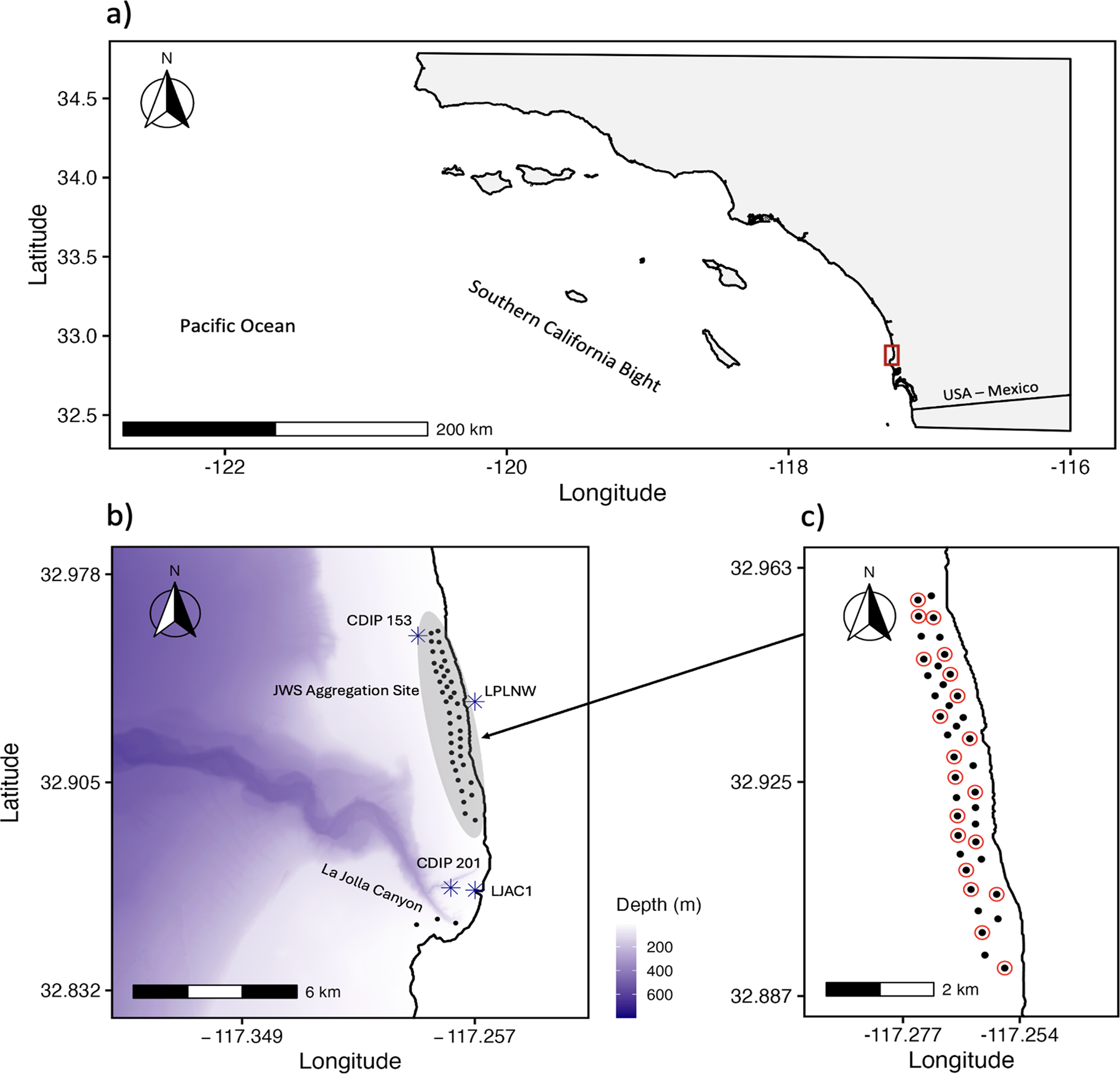
Extreme weather events, such as tropical storms, can pose profound disruption to nearshore marine environments. Although coastal ecosystems are particularly vulnerable to storm impacts, research describing the response of marine taxa to extreme weather remains limited, especially for highly mobile marine predators. In this study, we use acoustic telemetry to investigate the behavioral responses of juvenile white sharks (Carcharodon carcharias) at a Southern California nursery aggregation site to Tropical Storm Hilary in 2023. To aid in these efforts, we developed a novel occupancy modeling approach to statistically account and correct for temporal variations in acoustic receiver performance during disruptive storm conditions. Using detection data from synchronization transmitters, we first estimated the effects of key environmental factors on transmitter detection efficiency, with ambient noise, receiver tilt, and the density of animal transmitters present inside the receiver array emerging as particularly influential predictors. We then leveraged these estimated effects to inform a Bayesian state space model designed to investigate nursery occupancy dynamics, including environmental drivers of nursery emigration. Our results provide evidence of partial nursery evacuation, with over half of tagged sharks temporarily leaving monitored nearshore habitats in response to peak storm conditions. However, most emigrations were short-lived, with all but one shark returning to the aggregation site within three weeks of the storm. Evacuations from nursery habitats were best predicted by falling sea surface temperatures, although increased wave height, declining barometric pressure, and drops in salinity may have served as important secondary flight cues. Our efforts provide a rare opportunity to document the storm response behaviors of a recovering top predator, while also presenting tangible analytical solutions to commonly encountered technical challenges in the field of acoustic telemetry.

