
2026-07-27 カリフォルニア大学サンタバーバラ校(UCSB)
<関連情報>
- https://news.ucsb.edu/2026/022718/ucsb-led-international-team-evaluates-anoxic-marine-basins-potential-sites-carbon
- https://bg.copernicus.org/articles/23/3755/2026/
アイデアと展望:Max MACS – CO2除去のための海洋無酸素炭素貯蔵の潜在的な世界規模を制限する Ideas and perspectives: Max MACS – constraining the potential global scale of Marine Anoxic Carbon Storage for CO2 removal
Morgan Reed Raven, Nitai Amiel, Dror L. Angel, James P. Barry, Thomas M. Blattmann, Laura Boicenco, Antoine Crémière, Natalya Evans, Nora Gallarotti, Sebastian Haas, Jan-Hendrik Hehemann, Peter Krost, Pranay Lal, David Lordkipanidze, Tiia Luostarinen, Aaron M. Martinez, Allison J. Matzelle, Selma Menabit, Mihaela Muresan, Andreas Neumann, Jean-Daniel Paris, Christopher R. Pearce, Nick Reynard, Daniel L. Sanchez, Florence Schubotz, Violeta Slabakova, Adrian Stanica, Elena Stoica, Andrew K. Sweetman, Tina Treude, Yoana G. Voynova, and Nikolaos D. Zarokanellos
Biogeosciences Published:08 Jun 2026
DOI:https://doi.org/10.5194/bg-23-3755-2026
Abstract
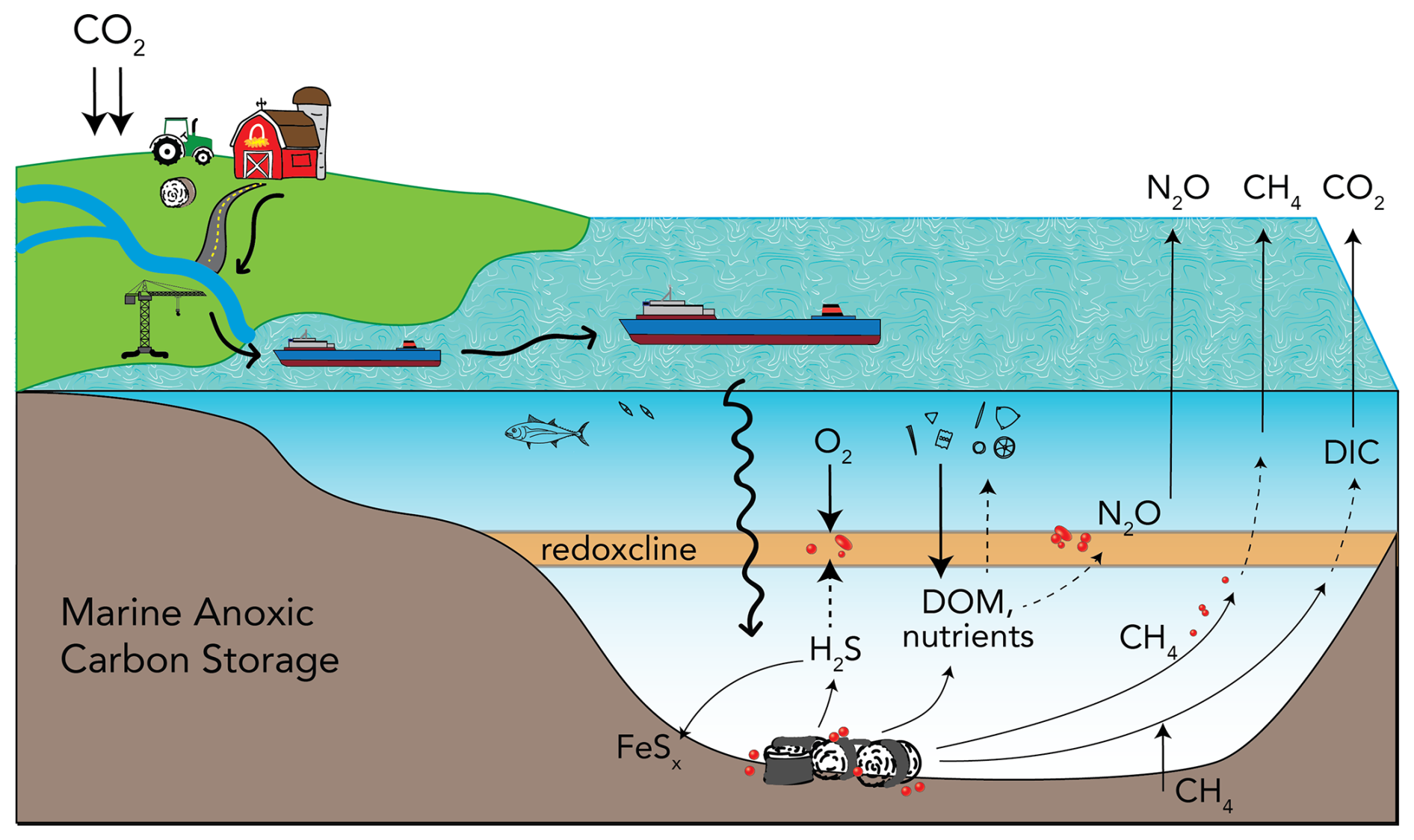
Marine Anoxic Carbon Storage (MACS) is a potential strategy for enhancing atmospheric CO2 removal (CDR) by sequestering organic carbon produced by terrestrial plants in stable, anoxic marine reservoirs. Initial results suggest that MACS could, in theory, operate at the gigatonne scale that would be required to impact global climate, with limited environmental risk and promising opportunities for co-benefits. However, several outstanding knowledge gaps make it challenging to quantify the actual potential global scale of MACS with confidence. To inform decisions about climate mitigation and trade-offs in the future, it is essential that we know how MACS implementation at scale would impact critical environmental and economic systems in the context of likely future scenarios.
Building on the results of a workshop in Bucharest, Romania in 2025, we discuss the potential impacts of MACS activities on the ecology, biogeochemistry, economy, and community around the Black Sea, seafloor brines, and other anoxic marine sites. Quantifiable limits to the potential maximum feasible scale of MACS for CDR are organized into five criteria: (1) Durable storage site capacity; (2) Biomass sources and logistics; (3) Greenhouse gas balance; (4) Oxygen and sulfide impacts at the redoxcline; and (5) Impacts on dissolved organic matter or nutrients in the oxic zone. For each criterion, we evaluate the factors that could limit scale, our current state of knowledge, and the priority knowledge gaps that, if addressed, would improve our ability to estimate the potential global scale of MACS for CDR. Research is needed to understand its potential impacts at scale, but MACS is nonetheless worthy of serious consideration as a potential pathway for climate mitigation in coming decades.

