2026-07-27 ミネソタ大学
<関連情報>
- https://cse.umn.edu/college/news/trace-additive-could-help-compostable-pla-plastics-break-down-backyard-bins
- https://pubs.acs.org/acscii/article/12/7/965/5226468/Dramatic-Enhancement-in-Polylactide-Hydrolysis-and
低濃度の有機無水物をマスク酸として利用することで、ポリ乳酸の加水分解性と生分解性を劇的に向上させる Dramatic Enhancement in Polylactide Hydrolysis and Biodegradability Utilizing Low Levels of Organic Anhydrides As Masked Acids
Jinsol Yook;Eric D. Rachita;Naba K. Kalita;Christopher J. Ellison;Marc A. Hillmyer
ACS Central Science Published:June 17, 2026
DOI:https://doi.org/10.1021/acscentsci.6c00395
Abstract
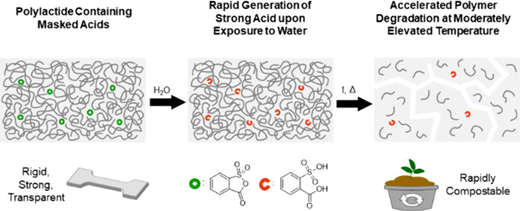
Polylactide (PLA) is the world’s top synthetic biopolymer and a major contributor to the circular plastic economy by virtue of its biodegradation and full biomineralization into benign end products. Nevertheless, efficient and complete degradation of PLA at its end of use remains constrained by the need for engineered industrial composting environments that operate at elevated temperatures and high humidity levels. In this work, PLA samples containing low levels of phthalic or 2-sulfobenzoic acid anhydride additives were prepared using industrially viable melt-processing. These blends retained mechanical properties nearly identical to that of neat PLA while exhibiting significantly accelerated hydrolytic degradation, achieving appreciable mass losses within one month at 50 °C in artificial seawater. Remarkably, even trace (0.01 wt %, 100 ppm) incorporation of 2-sulfobenzoic acid cyclic anhydride proved highly effective in promoting PLA hydrolysis even at temperatures below the glass transition temperature of the parent material. Furthermore, incorporation of 2-sulfobenzoic acid cyclic anhydride (0.1 wt %) enabled rapid biodegradation under composting conditions at 58 °C, achieving 90% within 11 days, surpassing that of neat PLA. Using anhydrides as strong acid-generating additives enables acceleration of PLA hydrolysis and biodegradation without compromising its other attractive properties, thereby opening a viable pathway toward realizing the full potential of PLA in a larger array of applications.