2026-07-23 テキサス大学オースチン校(UT Austin)
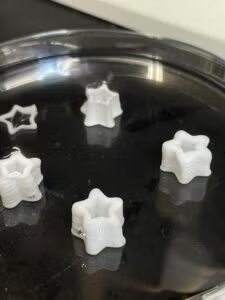
This 3D printed tissue mimics human tissue’s ability to sort and filter, allowing certain molecules to pass through while keeping others out. Credit: The University of Texas at Austin
<関連情報>
- https://news.utexas.edu/2026/07/23/3d-printable-material-can-heal-the-body-build-better-robots-and-recover-critical-minerals/
- https://www.nature.com/articles/s41563-026-02679-3
3Dプリント可能な生体組織模倣体としての、密集した相互接続二層エマルジョン Jammed interconnected bilayer emulsions as 3D-printable biological tissue mimics
Aida Fica,McKayla Torbett-Dougherty,Samuel West,Malika Rao,Raman Dhiman,Jun Wang,Yang Gao,Yu-Ming Tu,Harekrushna Behera,Claude Roc,Kyler Grogan,Alexandra Beaver,Chang Liu,Alexander Jui-An Lin,Brian Belardi,Benjamin K. Keitz,Robert J. Hickey,Zunlong Ke,Adrianne M. Rosales,Berkin Dortdivanlioglu,Stephen A. Sarles &Manish Kumar
Nature Materials Published:17 July 2026
DOI:https://doi.org/10.1038/s41563-026-02679-3
Abstract
Here we present jammed interconnected bilayer emulsions (JIBEs) as a class of tissue-like materials with macroscopic scalability, comprising billions of bilayer-separated aqueous compartments per millilitre. These materials mimic the organizational structure and properties of biological tissues. Our self-assembly method generates up to decilitre-scale volumes of JIBEs within minutes. The process is highly adaptable to a wide range of amphiphiles, including lipids and block copolymers, providing flexibility in tailoring JIBEs for diverse applications. The jammed architecture of JIBEs imparts unique properties, such as direct extrusion 3D printability into aqueous solutions. Their membrane-bound structure allows functionalization with nanochannels, enabling the material to adopt the properties of the incorporated channels. In this study, we demonstrate three key features of JIBEs using distinct ion channels: tunable conductance, selective transport and memristance. We propose that functionalized JIBEs could unlock a broad range of applications, including separations, energy storage, neuromorphic computing, tissue engineering, drug delivery and soft robotics.