2026-07-21 カリフォルニア大学リバーサイド校(UCR)
<関連情報>
- https://news.ucr.edu/articles/2026/07/21/new-technique-enables-ligo-peer-farther-distant-universe
- https://iopscience.iop.org/article/10.1088/1361-6382/ae86aa
重力波検出器のレーザー出力限界を克服するためのエラー信号 Error signals for overcoming the laser power limits of gravitational-wave detectors
Liu Tao, Pooyan Goodarzi and Jonathan W Richardson
Classical and Quantum Gravity Published: 16 July 2026
DOI:10.1088/1361-6382/ae86aa
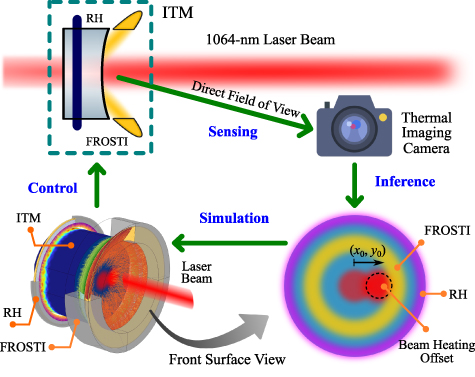
Abstract
A major barrier to improving the quantum-limited sensitivity of gravitational-wave observatories is the thermal distortions of the test masses which arise at megawatt laser power. Recent advances in a new form of higher-order wavefront correction, in which corrective heating profiles are applied to the test mass surfaces near their edges, together with other planned instrumental upgrades, have the potential to enable a tenfold reduction of the quantum noise floor of future detectors. However, realizing high levels of quantum noise reduction in practice hinges on identifying measurable error signals to finely control each wavefront actuator, in order to suppress wavefront errors to a few-nanometer precision across the full mirror apertures. No direct source of such an error signal exists in Laser Interferometer Gravitational-Wave Observatory (LIGO) today. We demonstrate that thermally imaging the surface of each test mass, with a calibration provided by existing Hartmann wavefront sensors, can provide these critical error signals. We show that the surface temperature profiles obtained from thermal imaging can be uniquely mapped to a finite element model of the mirror whose complete thermal state is identified, enabling full-aperture wavefront reconstruction and direct error signals for real-time precision wavefront control. This new sensing capability can enable up to a 31% strain sensitivity improvement in LIGO A+ at 95% confidence, increasing the sky-averaged detection range for binary neutron star mergers by 10 Mpc, and will be integral to a next-generation 40 km gravitational-wave observatory in the U.S., Cosmic Explorer.